Three weeks after launch, Crimson Desert is already staring down the kind of make-or-break moment that defines modern open-world games: either the developer meaningfully responds to player pain points, or the conversation curdles into “missed potential” discourse forever. Pearl Abyss is clearly trying to steer this ship hard in the right direction, outlining a packed April–June roadmap that targets the game’s biggest long-term issues—especially the late-game world feeling strangely empty once you’ve “saved” it.
The headline additions are exactly the sort of stuff players have been begging for: boss rematches, enemy territory recapture (re-blockading), and proper difficulty settings. But the deeper story is how aggressively Pearl Abyss is also tackling quality-of-life friction—controls, storage, UI readability, cosmetics, and underpowered playable characters—without pretending the launch week didn’t land with a thud.
A Roadmap That Actually Hits the Pain Points
Pearl Abyss’ dev update lays out features planned to roll out gradually from April through June, and what stands out is how directly it addresses the community’s most repeated complaints.
Enemy outposts can be recaptured (finally making Pywel feel alive again)
One of Crimson Desert’s most persistent late-game problems is that success can make the world feel worse. Clear enough camps, liberate enough locations, and Pywel starts to feel… quiet. Static. Like you’ve vacuumed up the game’s conflict and left behind a gorgeous theme park with nothing to push back.
Pearl Abyss is responding with a system that allows enemy remnants to reclaim liberated locations—described as re-blockading—so the world doesn’t stay permanently “solved.” This is a foundational fix, not a gimmick. Open-world games live or die on the illusion that the world continues without you, and right now Crimson Desert has been struggling with that illusion once players hit the back half.
If Pearl Abyss nails the tuning—frequency, variety, rewards—this could become the update that makes the game’s endgame loop feel sustainable instead of finite.
Boss rematches turn one-and-done highlights into a real endgame pillar
Boss fights are one of Crimson Desert’s most talked-about elements, and not always for universally positive reasons. They’ve been divisive among reviewers and players, but they’re also undeniably a core part of the game’s identity—big, cinematic, skill-testing encounters that feel like the game at its most confident.
The roadmap adds Boss Rematches, letting you fight previously defeated bosses again rather than having them effectively vanish after completion. Pearl Abyss frames it as a way to “test how much you’ve grown” and refine tactics through different strategies.
This is a huge deal for two reasons:
- It gives combat-focused players something repeatable and mastery-driven to chew on.
- It helps justify buildcraft and progression systems that can otherwise feel like overkill once the main path is done.
Boss rematches are also a smart pressure valve for balance complaints. If a boss is overtuned or undertuned, rematches plus difficulty settings (more on that below) give players more agency over how punishing they want the experience to be.
Difficulty settings are coming: Easy, Normal, Hard
At launch, Crimson Desert didn’t offer traditional difficulty options, and that’s been a sticking point—especially in a game where some players feel the challenge curve smooths out too much over time, while others hit walls.
Pearl Abyss is adding three difficulty settings: Easy, Normal, and Hard. The studio’s messaging is clear: this is about letting “everyone—from new Greymanes to the more advanced—enjoy the adventure at the level that suits them best.”
This is one of those updates that sounds basic until you remember how many open-world action RPGs are defined by accessibility and personalization. Difficulty settings aren’t just about making things easier—they’re about letting players choose the kind of experience they want. Some people want a brutal combat sandbox. Others want to explore Pywel and soak in the spectacle without getting hard-stopped by a single encounter.
Pearl Abyss is also teasing new combat-focused content in the works, though it hasn’t said what that actually is yet. Difficulty options arriving ahead of that content is a strong sign the team wants the next phase of Crimson Desert to support both power fantasy and high-skill play.
Damiane and Oongka Are Getting Buffed—And They Need It
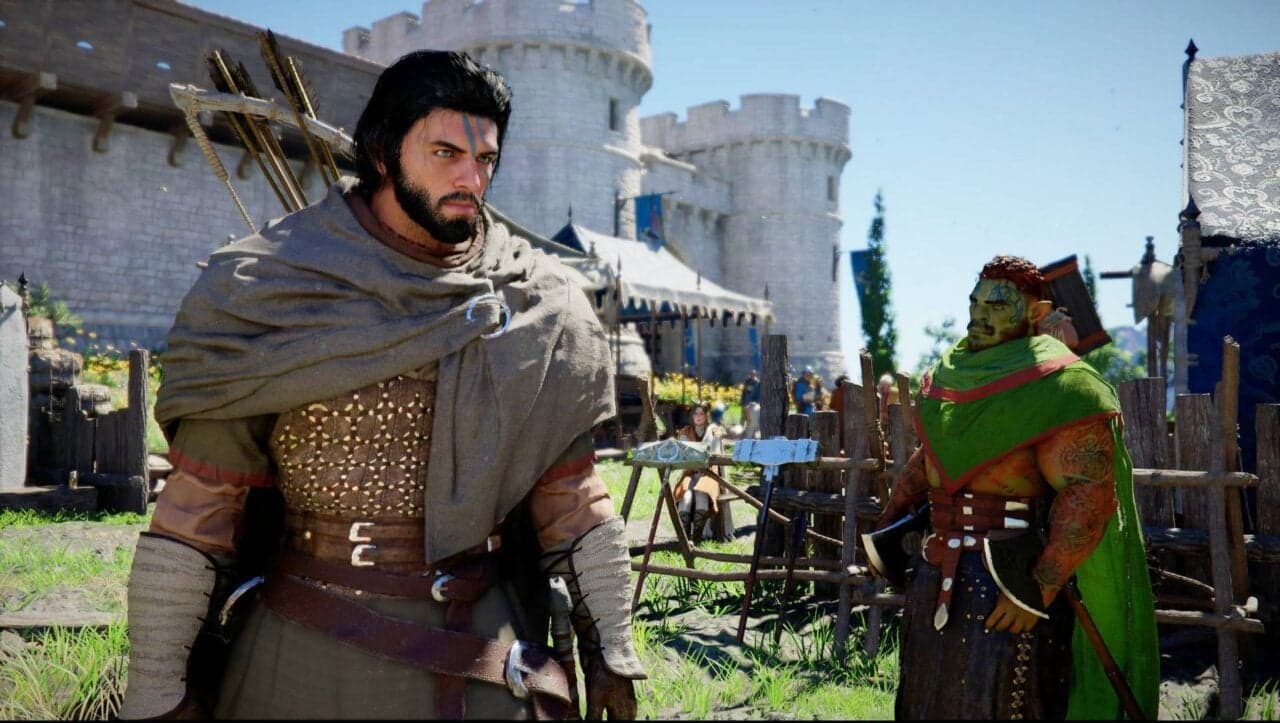
One of the most interesting parts of the roadmap isn’t about Kliff at all. Pearl Abyss is boosting Damiane and Oongka, the game’s two non-Kliff playable characters, by giving them new abilities comparable to Kliff’s Force Palm and Axiom Force.
That matters because Kliff’s skill tree—and the way his abilities interact with exploration and puzzle content—has effectively made him the “real” character for a lot of the game. The dev update acknowledges feedback that Damiane and Oongka feel neutered by comparison, and the planned skills are meant to close that gap.
This is more than a balance patch; it’s a statement about the game’s structure. If Crimson Desert wants its alternate playable characters to feel like legitimate options rather than novelty picks, they need parity in the kinds of tools the game expects you to use.
It’s also telling that some players may not even realize how much content is gated or awkward with those characters right now—Pearl Abyss improving them suggests the studio knows this is a friction point that can quietly poison long-term engagement.
Quality-of-Life Fixes: Storage, Controls, UI, Cosmetics, and Immersion
The roadmap isn’t just about big-ticket features. It’s also packed with the kind of practical improvements that determine whether players stick around between major content beats.
Specialized storage is coming (wardrobe, food, crafting materials, collections)
Inventory management has been a recurring pain point, and Pearl Abyss is expanding storage beyond a single “everything box” approach.
Planned improvements include specialized storage systems with dedicated spaces/tabs for categories like:
- A wardrobe for clothing/armor
- Food/ingredients storage
- Gatherables and crafting/tempering resources
- Collections, including quest items and recipes
There’s also an important usability detail: you’ll be able to prepare meals using ingredients that are in storage, not just what’s in your immediate inventory. That’s the kind of change that sounds small, but it dramatically reduces busywork—especially in a game that wants you crafting, cooking, and hoarding materials across dozens of hours.
Controls are being revisited, with more customization planned
Crimson Desert has developed a reputation for a weird, unintuitive control scheme, and Pearl Abyss is at least acknowledging the issue. The roadmap teases more customizable controls, including:
- Customization options for certain controller inputs
- An expanded range of configurable keys for keyboard and mouse
This is a step in the right direction, though it’s also a tacit admission that the default scheme hasn’t landed. Control customization is the minimum bar in 2026 for a big-budget action RPG—especially one that asks players to execute complex combat strings and traversal interactions.
UI accessibility: minimum font size adjustment
UI readability is getting attention too, including an option to adjust minimum font size. Pearl Abyss notes this will take time to optimize across the game’s 14 supported languages, which is a rare bit of transparency that I appreciate. UI changes can be deceptively complex in multilingual releases, and it’s better to set expectations than to ship a broken accessibility toggle.
Cosmetics: new outfits, previously unusable outfits become wearable
Cosmetic customization is getting a boost with new outfits, plus a particularly player-pleasing change: some outfits that previously could only be sold or donated will be updated so they can also be worn.
That’s a smart move because it turns what used to feel like “junk loot” into potential fashion options—and fashion is endgame in any open-world RPG whether devs admit it or not.
Hide back weapons option (immersion win)
Pearl Abyss is adding an option to hide weapons carried on the character’s back, so certain equipment won’t break immersion during combat and exploration. It’s a small toggle, but it’s exactly the kind of thing players notice constantly once it annoys them once.
New pets and mounts (plus armor sets)
The roadmap also includes new pets and mounts, with armor sets planned for them as well. Additionally, Pearl Abyss has teased summonable mounts as part of the upcoming improvements.
Mount systems are a huge quality-of-life factor in sprawling open-world games, and “summonable” is the keyword that matters here—because it usually signals less friction, less menu wrestling, and less “where did I leave my ride?” downtime.
Visual upgrades: distant scenery improvements
Pearl Abyss is also working on enhancing the realism and detail of distant background scenery, letting players enjoy Pywel’s landscapes “in greater depth.” This appears targeted at more powerful hardware, suggesting platform-specific scaling rather than a universal uplift.
In a game that sells itself heavily on spectacle and vistas, improving distant LOD and background detail can meaningfully change how the world feels—especially during traversal, climbing, and wide-angle exploration moments.
Bonus: the soundtrack is going free
Pearl Abyss has also announced the full Crimson Desert original soundtrack will soon be available for free on Steam and via streaming platforms. It’s not a gameplay fix, but it’s a goodwill move—and a way to keep the game’s identity circulating even among people taking a break until the next patch wave.
Release Timing, Platforms, and the Reality Check
Pearl Abyss’ plan is for these features to arrive gradually from April through June, but the roadmap does not attach specific dates to each item. The studio has also cautioned that details may change as features move through development.
Crimson Desert is currently available on PC, PlayStation 5, and Xbox Series X|S.
Commercially, the game has been a success—reported at over four million units sold to date—even as its launch reception has been divisive and its first weeks have required rapid patching. That combination (big sales + loud criticism + fast iteration) is exactly the scenario where a strong roadmap matters most. Pearl Abyss has the audience. Now it needs to earn their trust.
Why This Roadmap Feels Like Pearl Abyss “Gets It”
What makes this roadmap compelling isn’t just the feature list—it’s the philosophy behind it.
- Re-blockading addresses the open-world’s long-term health.
- Boss rematches turn content into repeatable mastery.
- Difficulty settings broaden the tent without diluting the experience.
- Damiane/Oongka upgrades fix a structural imbalance in playable character viability.
- Storage/UI/controls reduce friction that quietly bleeds players over time.
This is the kind of post-launch plan that can rehabilitate a game’s reputation—if it ships cleanly and doesn’t introduce new performance headaches. And that “if” matters. Big systemic changes (world state recapture, rematches, difficulty scaling) can create edge cases, bugs, and balance weirdness fast.
Still, as roadmaps go, this one is unusually aligned with what players actually complain about day-to-day. It’s not just “more content.” It’s “make the existing game feel better to live in.”
What Remains Unknown
- Exact patch dates for each feature between April and June haven’t been confirmed.
- Details on the teased “new combat-focused content” haven’t been revealed.
- It’s not yet clear how re-blockading will be tuned (frequency, rewards, scaling, whether it’s optional).
- The full scope of control scheme changes is still vague beyond added customization.
- No official details have been shared here about pricing changes or new editions; the roadmap focuses on updates and features rather than monetization.
- The roadmap mentions visual improvements to distant scenery, but performance impact and platform-by-platform specifics haven’t been detailed.
If Pearl Abyss delivers even most of this by June, Crimson Desert could look like a very different game by mid-summer—less static, less awkward, and far more replayable. And for players who bounced off during launch week, this is the clearest signal yet that the studio intends to fight for the long haul.