Playground Games has officially pulled the curtain back on the full Forza Horizon 6 map, and it’s the moment long-time fans have been waiting for: Japan, rendered as a festival-ready open world spanning Tokyo City, coastal roads, mountainous touge routes, and the snowy Japanese Alps. Better still, early hands-on previews are practically tripping over themselves to praise it—calling the map a “showstopper” and framing it as the kind of setting that could push Horizon to a new high.
Forza Horizon 6 launches May 19, 2026 on Xbox Series X|S and PC, with Premium Edition access starting May 15. A PS5 version is confirmed for later in 2026. Playground Games is developing, with Xbox Game Studios publishing.
What Playground Games Actually Revealed (and Why It’s a Big Deal)
The headline is simple: we now have the full Japan map image, shared by Playground Games via the official Forza Horizon social channels. And it’s not just a teaser slice—this is the zoomed-out, “here’s the whole playground” reveal that lets fans start doing what they always do: zooming in, tracing roads, and trying to reverse-engineer scale, landmarks, and route density.
Playground is describing this as its “most dense and vertical map yet”, and the image backs up the intent. The road network sprawls outward from Tokyo into a web of countryside routes, switchbacks, and long connectors that look built for exactly what Horizon does best: letting you point a car toward the horizon and keep finding reasons not to stop.
The studio’s leadership has been consistent about the ambition here. Art director Don Aceta has described it as the series’ biggest ever map, and also emphasized that it’s not just bigger—it’s meant to be full, with discoverable points of interest and activities around the corner rather than empty space between icons.
There’s also an important detail that’s easy to miss if you only look at the image: the map reveal shown is specifically the summer configuration, because seasons are in play and the world will change across the year. That matters, because seasonal shifts can dramatically alter how roads feel—especially when you’re dealing with mountain regions and snow-heavy areas.
Tokyo City, Touge Roads, Expressways, Alps: The “Greatest Hits” Japan Fantasy (Done With Intent)
Let’s talk about what’s actually in this version of Japan—because Horizon has never been about strict geographic fidelity. It’s about a curated driving fantasy, and the early impressions suggest Playground knows exactly what fantasy players are chasing.
Tokyo City is the biggest urban area Horizon has ever attempted
Multiple previews converge on the same point: Tokyo City is a major flex. It’s being described as the largest in Forza Horizon history, with one report claiming the Tokyo City area is five times larger than other urban environments the series has done before. That’s enormous for Horizon, a franchise where cities have often been gorgeous but relatively bite-sized compared to the countryside.
And yet, there’s an interesting tension here: even with Tokyo being the biggest city Horizon has built, it still appears as a compact cluster compared to the broader road network surrounding it. That’s not necessarily a knock—it’s arguably the correct call. Tokyo is famously sprawling, and trying to 1:1 it would be a fool’s errand. Horizon needs a city that plays well at speed, supports drifting and street racing, and connects cleanly to the rest of the map.
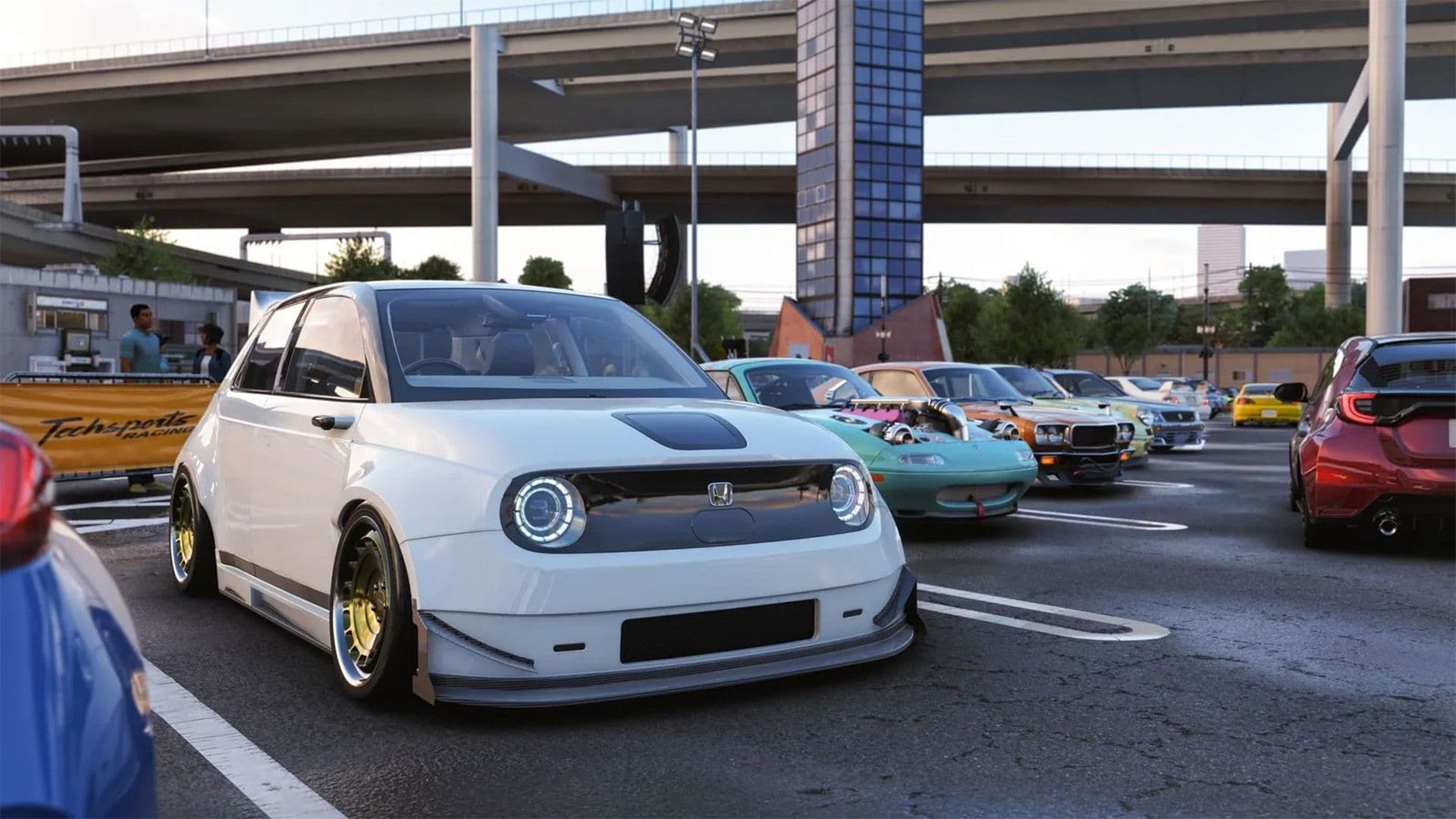
What’s especially promising is the attention to “lived-in” detail. One hands-on account highlights the Shuto Expressway threading through the skyline with views of vertical neon and Tokyo Tower, alongside surprisingly granular set dressing—everything from EV charging stations to bustling lanes and even the interiors of sushi trains. That’s the kind of texture that makes Horizon’s “digital tourism” hook land.
The Shuto Expressway and the C1 Loop are built for night runs
If you’ve ever wanted Horizon to fully embrace the “Tokyo at night” street-racing vibe, this is the entry that’s openly leaning into it. The map includes the C1 Inner Circular Route, an expressway loop described as 14.8 kilometers long—exactly the kind of road you use to test top speed, run highway pulls, and stage multiplayer cruises that turn into chaos.
This matters because Horizon’s best moments often come from roads that support flow: long stretches, clean interchanges, and enough width to let players make mistakes at 160 mph without instantly pinballing into a wall. A proper expressway loop is basically a playground within the playground.
Touge roads and “Touge Battles” are a natural fit for Horizon’s drifting obsession
Japan without touge is like Horizon without a festival—it just doesn’t compute. The map and previews point to switchback mountain roads designed for drifting, and there’s explicit mention of Touge Battles taking place on mountain passes.
Specific locations are being called out, too. The map includes routes tied to Mt. Haruna, and fans have been scanning the image and claiming they’ve spotted a road along Mount Akina. There’s also mention of Hakone Nanamagari, a famous drifting course, and Nikko Circuit being spotted by eagle-eyed viewers.
It’s worth being careful here: some of these are “spotted on the map” interpretations rather than a formal checklist of licensed locations. But the direction is unmistakable—Playground is building a Japan that understands why players begged for Japan in the first place.
The Japanese Alps and snow regions look like they’re built for spectacle
The map stretches from Tokyo down toward coasts and up into mountainous regions, including a portion of the Japanese Alps. There’s mention of the Tateyama Snow Corridor, and at least one preview describes a dramatic northern region with wide snowy descents that feel tailor-made for Horizon’s big cinematic races.
One hands-on report even notes that a chunk of the world appears to be permanently covered in snow, and that the map feels more dramatic and less “realistic” than previous Horizon maps—suggesting Playground is using elevation and extremes to create memorable driving set pieces, not just pretty vistas.
Coastal roads, beaches, and off-road connectors are back in force
The full map image shows beaches lining the southern coast, with mountainous terrain in the north, and a network of winding off-road tracks connecting into paved roads and urban areas. That blend is crucial. Horizon lives and dies on the ease of switching fantasies: supercar street runs one minute, rally chaos the next.
The early read is that Playground has once again “woven the two road systems together,” which is exactly what you want. A Horizon map shouldn’t feel like separate biomes stitched together—it should feel like one continuous place where you can improvise routes and make your own fun.
The Big Structural Shift: Progression, Tourism, and a Map You Don’t Fully See at First
The map reveal is the flashy headline, but the more meaningful design story might be what Playground is doing to how you move through that map.
For the first time, Forza Horizon has “fog of war”
This is a genuine series-first: Forza Horizon 6 introduces fog of war, meaning locations won’t appear on your map until you physically visit them.
Design director Torben Ellert explained the intent on the official Xbox podcast: “This new system is designed to tell you where you have been and what you have seen in a really legible way.” He also described a guiding rule for the Discover Japan content: “We have this rule with all of the Discover Japan content where if you find it, you can play it.”
That’s a deceptively big change. Horizon maps have traditionally been icon-heavy from the jump, showering you with activities and fast travel points until the world starts to feel like a checklist. Fog of war flips the psychology: it makes exploration feel like discovery again, and it gives the map reveal extra weight because players now know there’s a lot they won’t immediately have access to on their in-game UI.
A “journal” feature turns landmarks into collectibles
Playground is also leaning into Japan’s real-world tourism pull by adding a journal feature that lets you collect pictures of hotspots and landmarks, functioning like a diary of your trip.
That’s smart, and it fits the narrative framing being described: you’re initially an automotive tourist, an outsider who gets pulled into the country’s racing culture. It’s a more grounded angle than the “you’re already a superstar” vibe Horizon sometimes defaults to.
Progression is being reined in—less instant supercar fantasy, more earning your way up
One of the loudest recurring criticisms of recent Horizon games is how quickly they turn into a slot machine of rewards: cars, credits, wheelspins, and instant access to absurd performance. Some players love that. Others feel it kills the joy of climbing the ladder.
The early preview impressions suggest Forza Horizon 6 is deliberately trying to restore a sense of progression. You’re not immediately treated like an all-star, and you’ll need to prove yourself to earn entry to the festival. There’s also talk of having to earn the right to drive better and faster vehicles as you climb the ranks.
In the early hours, one preview player spent significant time in a ’90s Toyota Celica GT-Four, not a garage full of hypercars. Another hands-on preview describes starting with three vehicles: a 1989 Nissan Silvia K’s, a 1994 Toyota Celica GT-Four ST205, and a 1970 GMC Jimmy for off-road events.
That’s a strong “starter garage” vibe—iconic, flavorful, and functional, but not instantly game-breaking.
Barn finds may be out; random “aftermarket cars for sale” may be in
One preview describes encountering a car for sale in a village parking lot—randomly spawned aftermarket vehicles you can buy with credits—framed as a replacement for the barn finds of past games.
If that holds into the full release, it’s another subtle way Horizon 6 could feel less like it’s handing you everything for free. See a cool car? You might have to actually budget for it.
Fast travel changes: free to visited locations
Fast travel is also being tweaked. Instead of the old system where you’d smash boards to reduce fast travel cost, the preview describes fast traveling to previously visited locations as free, with colorful mascot statues acting as XP-granting smashables.
It’s a small change, but it aligns with the bigger theme: exploration first, convenience earned through familiarity, and less of the “map as a menu” feeling.
Hands-On Previews Are Raving — But They’re Also Flagging Familiar Horizon DNA
The early press previews are overwhelmingly positive about the Japan setting. The consistent refrain: the driving still feels like Horizon—smooth, satisfying, easy to grasp—but the map is the star.
One preview calls out the “authentic feeling of digital tourism” and says the world “oozes” immersion, with constant compulsion to explore. Another praises how Playground “captured the beauty of Japan,” emphasizing physics, surface simulation, and sense of speed that remain best-in-class.
There’s also praise for how the structure is being overhauled—more deliberate progression, more reasons to drive around without constantly being shoved into the next event.
But not every note is pure reinvention. One hands-on report argues that, aside from the scenery, almost nothing has changed: menus are similar (and still clunky), the map is still strewn with familiar side activities, and the core loop remains what it’s always been—tourism, speed, XP, and cars.
That’s not necessarily a problem. Horizon doesn’t need to become something else. What it needs—especially after the “bloat” criticism that followed Horizon 5—is a cleaner structure and a map that feels like a once-in-a-generation driving playground. Japan might be exactly that.
Release Date, Platforms, and What’s Confirmed So Far
Here’s what’s locked in:
- Release date: May 19, 2026
- Early access: May 15, 2026 for Premium Edition owners
- Platforms at launch: Xbox Series X|S, PC
- PS5: confirmed for later in 2026 (a “months after” arrival has been suggested, but no exact date is confirmed in the available details)
- Developer: Playground Games
- Publisher: Xbox Game Studios
- Setting: Japan, including Tokyo City and the Japanese Alps
- Map claims: “biggest ever,” “most dense and vertical”
- Key new feature: fog of war map discovery
- Seasons: the revealed map image reflects summer, with seasonal changes expected
- Car count: the final game promises more than 550 cars (as described in hands-on impressions)
What Remains Unknown
Even with the full map image out in the wild, there are still major questions that haven’t been officially nailed down:
- Exact PS5 release date and whether it lands closer to summer, fall, or holiday 2026.
- Full details on seasons (how dramatically the map changes, and whether snow coverage is seasonal or partly permanent in specific regions).
- Whether controversial reward systems from past games (like Wheelspins) are fully removed or simply weren’t present in preview builds.
- The complete list of cities/major metro areas beyond Tokyo; at least one hands-on preview suggests Tokyo may be the only major metropolitan area in the build they played.
- Full confirmation of specific “spotted” landmarks (like Mount Akina and Nikko Circuit) beyond what fans believe they’ve identified from the map image.
If Playground sticks the landing, Forza Horizon 6 could be the rare sequel that doesn’t just give the community what it asked for—Japan—but uses that setting to meaningfully sharpen what Horizon is supposed to be: a driving holiday you never want to end. The map reveal makes a strong case that this is the most ambitious open-world racer Playground has ever built. Now it just has to prove it can fill that gorgeous sprawl with a progression loop that respects your time as much as it rewards your curiosity.