Minecraft World is officially happening: Mojang Studios is teaming up with Merlin Entertainments to build a dedicated Minecraft theme park experience slated to open in 2027. It’s being developed as part of Chessington World of Adventures in Greater London, and it’s not just a branding exercise—Merlin is promising a “world-first Minecraft coaster,” themed retail and dining, and hands-on attractions designed to make the Overworld feel real.
If you’ve ever wondered what it would be like to step inside Minecraft’s blocky logic—where everything is a tool, a resource, or a potential disaster—this is the first time the franchise is making that leap at full theme-park scale in the UK. And given Minecraft’s cultural gravity, it’s a move that feels less like a novelty and more like the next inevitable expansion of the biggest sandbox in gaming.
Minecraft World: What’s Been Announced So Far
The announcement landed during the Minecraft Live showcase, with Mojang Studios and Merlin Entertainments confirming the project under the name Minecraft World. The plan is for it to open sometime in 2027, with Chessington World of Adventures named as the location where the experience will be built out.
Merlin’s official messaging frames it as a major, purpose-built addition rather than a small overlay. The project is budgeted at £50 million (reported as just shy of $70 million) and is described as featuring:
- A “world-first Minecraft coaster”
- Themed retail and dining
- A lineup of fan favourites and “ridiculous fun” drawn from the Minecraft universe
That “world-first” coaster phrasing is doing a lot of heavy lifting—and it should. Theme parks love superlatives, but Minecraft is uniquely suited to a coaster concept because its identity is instantly readable from silhouette alone. If Merlin nails the visual language—chunky geometry, bold color blocking, and that unmistakable “built, not sculpted” look—it could become a landmark attraction even for people who haven’t touched a crafting table in years.
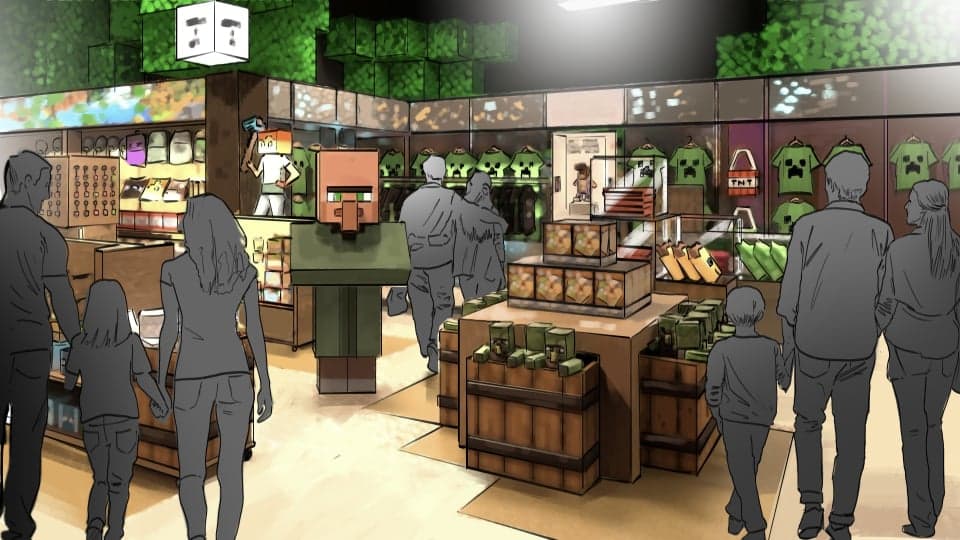
The Concept Art Sets the Tone: Blocky, Bright, and Very Early
Alongside the announcement, concept art has been shown, and it makes one thing clear: Minecraft World is still in a planning-stage presentation phase. The imagery functions more like an early promise of tone and layout than a final blueprint of what guests will experience.
That’s not a knock—it’s just the reality of theme park development. When you’re talking about a £50 million build, early mock-ups are meant to sell the vision internally and publicly: “Here’s the vibe, here’s the scale, here’s why you should care.” The final attraction mix, ride systems, and guest flow details typically come later.
What’s especially interesting is how Minecraft’s aesthetic flips the usual theme park challenge on its head. Most game-to-park adaptations struggle to translate stylized worlds into physical spaces without losing their identity. Minecraft’s identity is physical space—blocks, grids, and construction. If anything, the risk here isn’t “can they translate it?” but “can they make it feel alive rather than static?” Minecraft is about motion, surprise, and emergent chaos. A real-world version needs kinetic energy, not just photo ops.
What You’ll Do There: Attractions, “Mob Encounters,” and the “Biggest Minecraft Shop Ever”
Beyond the coaster, the announced feature list leans hard into the stuff that sells the fantasy of “being in the Overworld.” Promotional messaging points to:
- “Attractions and adventures”
- The “biggest Minecraft shop ever”
- Minecraft food
- Mob encounters
Those last two items—food and mobs—are where this could either become a genuinely memorable themed land or a fairly standard branded zone. “Minecraft food” could mean anything from clever, block-styled presentation to full-on menu items designed around in-game logic. And “mob encounters” is a loaded phrase: it could be meet-and-greets, roaming performers, interactive scare-style moments, or tech-driven effects. The announcement doesn’t lock down the format yet, but it’s clearly positioned as a core pillar of the experience.
Mojang’s official statement also emphasizes immersion and authenticity, describing the project as a major step in expanding Minecraft beyond the screen and into a place where fans can have their own adventure with family and friends. That’s the right pitch. Minecraft isn’t just a game you play—it’s a shared language across generations, and Merlin is aiming squarely at that broad audience.
A Collaboration With “Iconic Minecraft Creators” — But No Names Yet
One of the most intriguing details is that Minecraft World is said to be designed in collaboration with a selection of “iconic Minecraft creators” to help bring the universe to life “in the most authentic way possible.”
That’s a smart and potentially powerful move—if it’s executed meaningfully. Minecraft’s creator ecosystem isn’t just marketing fuel; it’s one of the biggest reasons the game has remained culturally dominant for so long. Builders, redstone engineers, survival challenge streamers, roleplay communities—Minecraft’s identity has been co-authored by its players for more than a decade.
But right now, no specific creators have been announced. Until names and roles are confirmed, it’s impossible to know whether this is deep creative involvement (design consultation, attraction concepts, in-park builds) or a lighter-touch partnership (branding, promotional appearances, curated references). Either way, it’s a detail worth watching, because it could be the difference between a park that looks like Minecraft and one that feels like Minecraft.
Why This Matters: Minecraft Is Joining the Big Leagues of Game Theme Parks
Video game theme park experiences aren’t new anymore—major IP has been steadily moving into physical entertainment. But Minecraft World is still a significant moment because it’s Minecraft: a franchise that has transcended “popular game” status and become a platform, a classroom tool, a content ecosystem, and a generational touchstone.
It’s also notable as a major UK-based play in the broader trend of game worlds becoming real-world destinations. Merlin putting £50 million behind this signals confidence that Minecraft isn’t just evergreen—it’s destination-worthy. And if it lands, it could set a template for how other publishers approach permanent, large-scale physical experiences outside the usual US/Japan theme park hubs.
There’s also a practical angle: Minecraft’s visual style is inherently brand-stable. You don’t need photoreal animatronics to sell the fantasy. You need strong theming, clever interactivity, and the kind of tactile design that makes guests feel like they’re inside a playable space. In other words: Minecraft might be one of the most “theme-parkable” games ever made—if the designers resist the temptation to make it purely decorative.
Release Window, Location, and Budget: The Concrete Details We Actually Have
Here’s what’s currently locked in with real specificity:
- Name: Minecraft World
- Developer/IP holder: Mojang Studios
- Partner: Merlin Entertainments
- Location: Built as part of Chessington World of Adventures in Greater London
- Target opening: 2027 (no exact date yet)
- Budget: £50 million (reported as just shy of $70 million)
- Key confirmed features: A “world-first Minecraft coaster,” themed retail and dining, plus additional attractions/adventures
Notably absent so far: ticket pricing, whether Minecraft World requires a separate admission tier, and how large the Minecraft-specific footprint will be within Chessington. Those details will matter enormously for families planning trips—and for fans deciding whether this is a must-visit pilgrimage or a “nice if you’re already there” add-on.
What Remains Unknown
Even with a flashy announcement and concept art, there are still big unanswered questions that will define what Minecraft World actually becomes:
- Exact opening date in 2027 (no month or season confirmed)
- Ticketing structure and pricing (no official details yet)
- How extensive the Minecraft World area will be within Chessington World of Adventures
- What the “world-first Minecraft coaster” actually is (ride type, height, intensity, theme specifics)
- What “mob encounters” means in practice (performers, animatronics, interactive tech, etc.)
- Which “iconic Minecraft creators” are involved, and what their roles will be
For now, the headline is simple and huge: Minecraft World is real, it’s coming in 2027, and it’s bringing a signature roller coaster with it. The next phase—names, ride details, and the real scope of the land—is where this announcement will either level up into a genuine theme park event… or settle into being a solid, family-friendly branded expansion. Either way, Minecraft is stepping out of the screen, and the UK is getting the first crack at living inside the blocks.