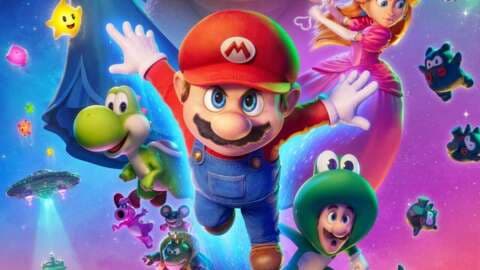
The Super Mario Galaxy Movie is in theaters now, it’s already putting up monster numbers, and—predictably—adults are arguing about whether it’s “good” or just a brightly colored conveyor belt of Nintendo references. So here’s the twist that actually matters: one of the most telling takes so far comes from a four-year-old Mario superfan, because if this movie is engineered for anyone, it’s kids first and everyone else second.
And while grown-up discourse is busy litigating story structure and emotional stakes, the kid review angle cuts straight to the point: did it feel like Mario, did it deliver the characters, and did it keep the target audience locked in? That’s the real battleground for Nintendo and Illumination—and it’s why this particular perspective is worth paying attention to.
A Kid’s-Eye Review Is the Most Honest Stress Test This Movie Can Face
Let’s be blunt: The Super Mario Galaxy Movie was always going to be critic-proof in the only way that counts for a family blockbuster—kids dragging parents (and parents surrendering to the cultural moment). Even the film’s own framing in the wider conversation reflects that tension: plenty of adult viewers are debating whether it’s “empty calories,” but the franchise’s gravitational pull is undeniable.
That’s what makes the four-year-old review concept so sharp. Adults can get tangled up in expectations—whether it should be more like the Super Mario Galaxy game’s cosmic melancholy, whether it should take bigger narrative swings, whether it should be “more demanding.” A kid doesn’t care about any of that. A kid cares about vibes, spectacle, characters they recognize, and whether the movie keeps moving.
And it’s not like this perspective is coming from a random toddler who’s never touched the series. The reviewer in question is described as a Mario-enthusiast child—exactly the demographic that these films are designed to hook for life. That’s the pipeline: you get them young, you make it memorable, you sell them the next movie, the next game, the next toy, the next amiibo, the next everything.
In other words, a four-year-old’s reaction isn’t a novelty—it’s market research with a pulse.
Nintendo and Illumination Didn’t Want a “Sequel,” They Wanted a New Launchpad
One of the more fascinating bits of context around The Super Mario Galaxy Movie is that it’s explicitly not meant to be treated as a direct sequel to 2023’s The Super Mario Bros. Movie. Illumination boss Chris Meledandri has said it was never designed to be a sequel, nor a straight retelling of the Super Mario Galaxy game.
That distinction matters, because it explains a lot about why the movie seems built the way it is: less “continuation,” more “new story using Galaxy’s ingredients.” Meledandri has talked about the team considering other directions for a follow-up—ideas like Super Mario World or Super Mario Odyssey—before landing on Galaxy because its qualities felt “immediately exciting,” especially the cinematic and dramatic potential tied to Rosalina and the way that character’s drama is reflected in Galaxy’s music.
That’s a very specific creative north star: Rosalina as emotional anchor. And the movie makes a major canon-style move right out of the gate: it confirms Peach and Rosalina are sisters, with Rosalina as Peach’s older sister, and the two living together in space. In the film’s setup, they’re attacked early on, and Rosalina sends Peach to the Mushroom Kingdom to keep her safe.
For longtime fans, that’s not a small detail—it’s the kind of “finally!” lore drop that Nintendo usually avoids committing to in the games. Whether that ever crosses back into the mainline series is anyone’s guess, but as a movie swing, it’s huge. It gives the film a built-in emotional relationship that doesn’t rely on the usual “Bowser kidnaps Peach, go!” loop.
And yes, it also gives Nintendo a clean runway for more cosmic, character-driven stories if it wants them.
The Cameo Cannon: 12 Big References, One Clear Strategy
If you felt like The Super Mario Galaxy Movie was a rapid-fire parade of “hey, remember this?” moments… that’s because it is. The film is stuffed with cameos and references—some blink-and-you-miss-it, some full-on “wait, they really went there.”
Among the biggest named cameos and deep cuts broken out in the conversation around the film:
- Mr. Game & Watch, summoned by Luigi near the end of the film, who helps fight Bowser and Bowser Jr. before being killed by them.
- Pikmin, briefly appearing in the Gateway Galaxy before Peach and Toad meet Fox McCloud.
- Baby Mario and Baby Luigi, after Bowser Jr. de-ages them.
- The Super Scope, used by Bowser Jr. and later Yoshi (with the movie giving it de-aging power).
- Honey Queen, appearing briefly as a minor antagonist—one of the few characters that actually originates from the 2007 Super Mario Galaxy game.
- Mouser, appearing in a casino segment alongside other Super Mario Bros. 2 baddies.
- Birdo, present but notably underused and without a speaking line.
- Wart, framed as an underground casino crime lord with connections to Bowser and Bowser Jr.
- R.O.B., appearing as a helpful robot in the Gateway Galaxy.
- Dry Bowser, after Bowser gets dropped into lava and emerges burned down to bone.
- Daisy, appearing as the final character in the post-credits scene, stopping an Ukiki from stealing in the Gateway Galaxy.
- Fox McCloud, not just a cameo but a full cast member, explicitly described as coming from a different universe (Star Fox).
This is Nintendo’s cinematic playbook in neon lights: build a movie that functions like a theme park ride through its own history. The upside is obvious—fans get the dopamine hit, kids get the spectacle, and the franchise becomes a shared language across generations.
The downside is also obvious, and it’s where adult criticism tends to land: if the movie becomes only a reference delivery system, it risks feeling like a highlight reel instead of a story.
But here’s the uncomfortable truth: for a four-year-old, the reference density isn’t a problem. It’s a feature. It’s a constant stream of stimuli and recognizable shapes and sounds. Adults may want “stakes” and “pathos.” Kids want momentum.
Box Office: It’s Already a Hit, Even If It Won’t Top 2023
Whatever you think of the movie creatively, the commercial story is already loud.
The Super Mario Galaxy Movie hit theaters on April 1 and pulled in $34 million in the US on opening day, making it the biggest opening day of 2026 so far, edging out Project Hail Mary ($33.1 million). It also set a record as the highest opening for a movie that opened on a Wednesday in April in US history, beating the Wednesday opening record previously held by April 2023’s The Super Mario Bros. Movie ($31.7 million).
Projections put Galaxy at $128.2 million over its first three days and $186 million over its first five days.
That’s enormous. It’s also, notably, projected to land below the 2023 film’s early run (which hit $146.3 million over its first three days and $204.6 million over its first five). But “not beating one of the biggest animated box office events in recent memory” is not the same thing as underperforming. This is still a rocket launch.
And it reinforces why the kid-focused review angle matters: the movie doesn’t need to win the critical argument. It needs to win the family outing.
The Jack Black Factor: New Mario Song, Not in the Movie, Still Part of the Machine
Jack Black remains one of the franchise’s most powerful marketing engines. Around the launch of The Super Mario Galaxy Movie, he debuted a new Super Mario song, following the viral success of “Peaches.”
The catch? The new song isn’t in the movie, which immediately raises the obvious question: why wouldn’t you put the thing that’s proven to be a social-media rocket booster directly into the film itself?
That question is part of the larger truth about how these movies are being packaged: the film is the centerpiece, but the surrounding ecosystem—songs, clips, memes, merch—does a ton of the heavy lifting in keeping the conversation alive.
Black also jokingly suggested a third Mario movie could arrive in 2029, saying: “Don’t be surprised if you hear that coming out next time, in 2029.” It was delivered as a joke during an interview, and there’s no official announcement attached to it—but the fact he tossed out a specific year is the kind of offhand comment that fans will cling to until Nintendo says otherwise.
The Merch Orbit: Galaxy amiibo Are Finally Out (and They’re Pricey)
Nintendo’s synergy machine doesn’t stop at the theater doors. On the same day the movie discourse is exploding, the Super Mario Galaxy amiibo figures are finally available—months after Super Mario Galaxy + Super Mario Galaxy 2 launched on Switch in October 2025.
Two figures are out:
- Mario & Luma
- Rosalina & Lumas
They’re priced at £24.99 / $39.99 each, and scanning them into Switch or Switch 2 unlocks 1up Mushrooms or Life Mushrooms in-game.
Let’s not pretend those unlocks are earth-shattering. They’re not. The value proposition here is clearly the figures themselves—collector appeal, display appeal, and the simple fact that Rosalina merch tends to move because Rosalina fans are relentless (and I mean that as a compliment).
It’s also a reminder of how Nintendo builds these moments: movie hype feeds game interest, game interest feeds collectibles, collectibles keep the brand physically present in your home long after the credits roll.
Critics vs. Kids vs. Fans: The Real Split That Defines This Movie
The early critical temperature is… not glowing. The film is sitting at a 42% critic rating on Rotten Tomatoes, and at least one prominent take frames it as a “sugary barrage of references” with impressive animation and competent action, but without an engaging story, genuine stakes, or meaningful humor—arguing that it’s essentially a cinematic version of “empty calorie” game design.
That critique also points out something important: even if a movie is “for kids,” kids still deserve stories that nourish imagination rather than simply dazzle. It’s a fair argument, and it’s one Nintendo should take seriously if it wants these films to have staying power beyond opening weekend.
But here’s where the four-year-old review lens becomes the perfect counterweight: Nintendo and Illumination are optimizing for delight, not discourse. The question isn’t “does this satisfy adult film criticism standards?” The question is “does this create a new generation of Mario diehards?”
And if the kid verdict is enthusiastic—if it lands with the people who will rewatch it endlessly, quote it on the playground, and beg for the toys—then the movie has succeeded at its primary mission.
Meanwhile, fan reaction is being actively solicited in the form of community scoring, with at least one major Nintendo-focused outlet giving the film a 6/10, praising visuals and faithful easter eggs while acknowledging plenty of flaws. That’s the middle ground many fans will likely settle into: not a masterpiece, but an enjoyable 90-ish minute Mario sugar rush.
What Remains Unknown
Even with the movie out and the conversation roaring, there are still big unanswered questions:
- No official announcement has been made for a third Mario movie, despite Jack Black joking about 2029.
- It’s unclear whether the film’s major lore swing—Peach and Rosalina being sisters—will ever be acknowledged in the games.
- The full details of Jack Black’s new Mario song rollout (and why it wasn’t included in the film) haven’t been formally explained in the public comments highlighted so far.
- While the movie is in theaters now and box office projections are strong, longer-term legs—and how repeat viewings compare to 2023—remain to be seen.
If you want the cleanest takeaway possible, it’s this: The Super Mario Galaxy Movie is doing exactly what Nintendo’s modern brand strategy is built to do—turn Mario into an all-ages, all-media gravitational force. Adults can argue about whether it’s “enough.” Kids will decide whether it’s unforgettable. And if the four-year-old review energy is anything to go by, Nintendo’s not losing sleep.