The Super Mario Galaxy Movie is already a box office juggernaut, stuffed to the brim with cameos, visual detours, and big franchise-swinging ideas. And yet it somehow leaves one of the easiest crowd-pleasers on the table: Jack Black’s Bowser never gets a full-blown song. After “Peaches” became the previous film’s defining pop-culture moment, the sequel’s decision to keep Bowser mostly quiet feels less like restraint and more like a baffling misread of what audiences actually show up for.
So why doesn’t Jack Black sing? There’s no official, on-the-record explanation from Nintendo, Illumination, or Universal—at least not yet. But the movie itself gives us plenty of clues about how this sequel is built, what it prioritizes, and how Bowser’s screen time gets squeezed by the film’s relentless pace.
The Short Version: The Movie Is Too Busy to Let Bowser Breathe
The clearest “answer” is also the most frustrating: the film is a frantic speed run, constantly hopping from set piece to set piece and stacking references on top of references. It finds time for all sorts of side business—like a full animated backstory beat for Glen Powell’s Fox McCloud, plus other detours—yet it doesn’t carve out space for a proper Bowser musical number.
Bowser does briefly “subvocalize a sorta-tune” while walking through a dollhouse prison (a holdover consequence from the first film’s events), but that’s a tease, not a moment. It’s the cinematic equivalent of clearing your throat and never singing the chorus.
And that’s what makes it sting: in this animated movie continuity, Bowser isn’t just a villain who could sing. He’s effectively been established as someone who does sing—canonically a performer who uses music to express his big, ridiculous emotions. The sequel doesn’t just skip a fun gag; it sidelines a character trait the franchise itself helped popularize.
“Peaches” Wasn’t Optional—It Was the Franchise’s Secret Weapon
Let’s be blunt: “Peaches” wasn’t a throwaway joke in the first Mario movie. It was the breakout. It was the moment that cut through the “cute for kids” veneer and gave older viewers something knowingly absurd to latch onto—humor aimed at the parents in the theater as much as the kids.
It also became a marketing gift. Jack Black sold the song with the kind of committed, theatrical energy that turns a meme into a moment, and the live-action performance video was basically engineered for virality. In the modern blockbuster ecosystem, that kind of lightning-in-a-bottle is priceless.
And Jack Black, as a performer, is practically built for this. He’s a longtime musician, he’s known for musical comedy, and he’s repeatedly proven that if you give him even 45 seconds and a melody, he’ll turn it into a headline.
Which is why the sequel’s silence is so strange. The audience appetite is obvious. The performer is eager. The character is already set up for it. The only missing ingredient is the movie’s willingness to slow down long enough to let it happen.
The Galaxy Movie Hands Bowser Multiple Perfect Song Setups… Then Rushes Past Them
What’s wild is that the Super Mario Galaxy Movie practically begs for musical beats—especially for Bowser. The story puts him through emotional pivots that scream for a villain ballad or a comedic showtune confession.
There are several moments that feel tailor-made for a song:
- Bowser pleading with Mario to un-shrink him so he doesn’t have to face his estranged son while tiny. That’s a classic musical-theater setup: vulnerability, humiliation, stakes, and a character trying to persuade the hero.
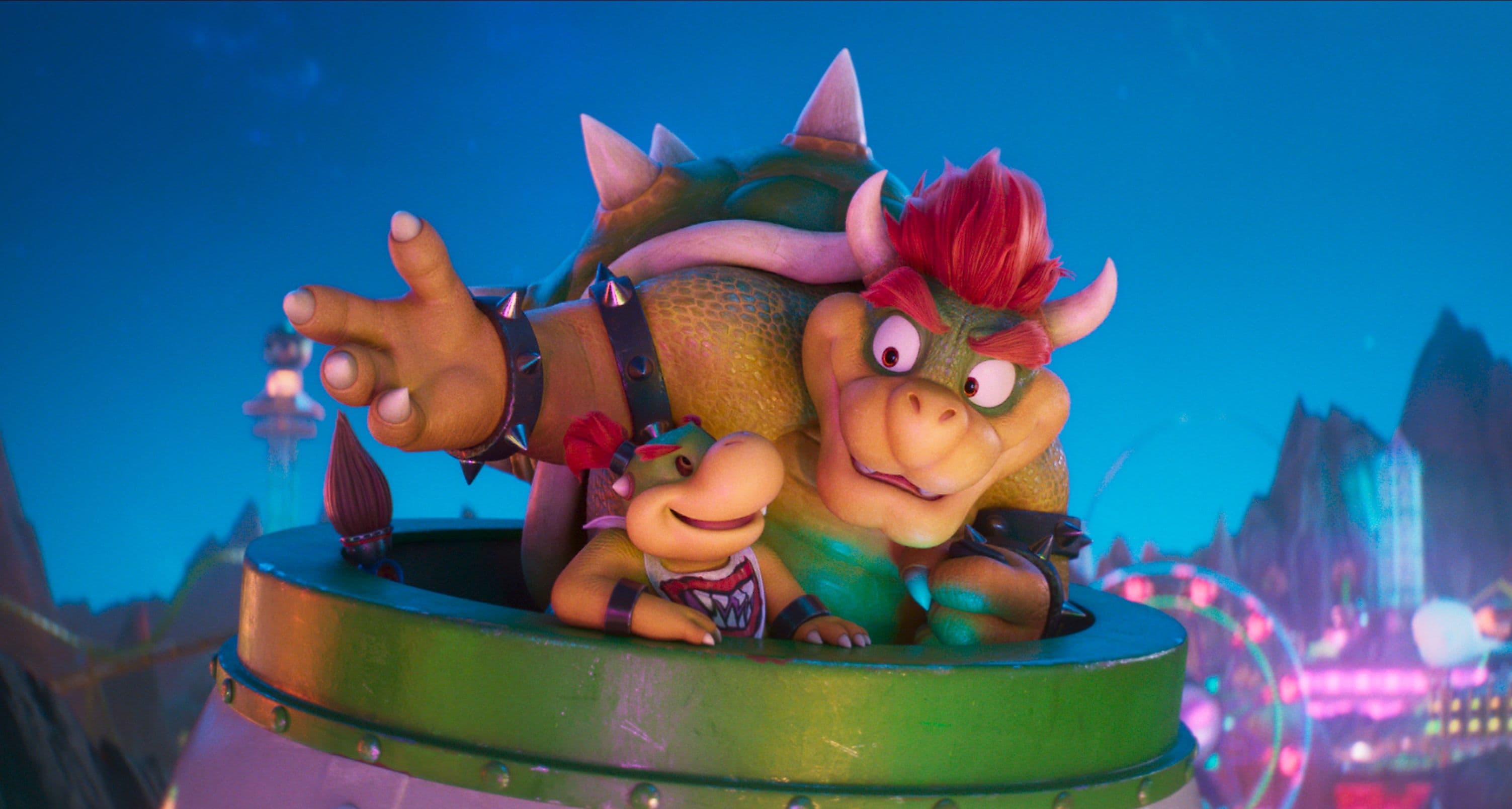
- Bowser’s reunion with Bowser Jr. (voiced by Bennie Safdie) is another obvious candidate. Father-son duets are a time-tested way to turn emotional exposition into something audiences actually feel.
- The tour of “Bowser World” has the kind of sweeping, show-and-tell energy that animated musicals love—big visuals, big feelings, big “look at my kingdom” energy.
But the biggest missed opportunity is the one that should have been unavoidable: Bowser confronting whether captivity changed him, or whether he’s still a villain at heart. That’s villain-song territory. That’s the exact narrative space where animated films traditionally drop the “here’s who I am” anthem.
Instead, that beat “barely gets a moment for consideration.” The film moves on.
And when a movie is moving that fast, a musical number isn’t just a fun extra—it’s a structural pause. It forces the story to stop and sit in a character’s head. This sequel doesn’t want to stop. It wants to sprint.
The Sequel’s Biggest Flex Might Be… Not Mario
If you want to understand the Galaxy Movie’s priorities, look at what it does slow down for: Fox McCloud.
There’s a sequence where Peach and Toad meet Fox in the Gateway Galaxy, and the film briefly shifts into an “incredible-looking” 2D anime art style while Fox recaps his backstory—pulled from his home dimension into Mario’s and unable to find his way back. It’s stylish, bold, and—crucially—time-consuming in a movie that otherwise doesn’t like to linger.
That detour is so striking that it’s been singled out as the movie’s coolest segment, even though it’s “completely divorced from the Mushroom Kingdom.” It’s also been noted that the movie doesn’t ultimately do much with Fox’s plotline; he’s there to look cool, steal scenes, and (as framed by commentary around the film) potentially help stoke interest in a rumored upcoming Switch 2 Star Fox game.
The 2D sequence was led by supervising animator Benjamin Faure, who said in a post that he was “truly honored” to be in charge of the 2D Fox intro sequence and shouted out original Fox character designer Takaya Imamura.
All of that is to say: the movie can slow down. It chooses where to spend that time. And it chooses to spend it on a flashy cross-franchise flex instead of giving Bowser the kind of musical moment that previously defined him.
That’s not inherently wrong—Fox’s sequence sounds like a genuine creative swing—but it does explain why Bowser’s song gets squeezed out. The film is budgeting its oxygen for spectacle, not character.
Bowser Still Gets Big Moments—Just Not the One Everyone Wanted
Bowser isn’t absent. He’s central to some of the movie’s strangest, most lore-bending ideas—like the “suicide roller coaster” on Planet Bowser that dunks Koopas into lava and turns them into Dry Bones.
Yes, really.
The film presents an amusement park coaster where riders are submerged in lava, emerging as undead skeletal versions of themselves. Bowser himself becomes Dry Bowser after an unplanned lava dip. It’s one of those “only Mario” concepts that’s both hilarious and faintly unhinged, and it’s sparked exactly the kind of fan brain-spiral you’d expect: what does it feel like to become Dry Bones?
Jack Black and Bennie Safdie even weighed in with their own theories. Safdie compared it to cracking your knuckles—dangerous-looking, then a reorientation and you’re fine. Black likened it to a chiropractic adjustment: it hurts for a second, then feels great. Black also joked there’s a downside for foodies: as a skeleton, “it just goes right through [your skeleton]. It ruins any good meal.”
That’s great color. It’s memorable. It’s very Jack Black.
But it’s also telling: the movie gives Bowser bizarre set pieces and comedic bits—yet it doesn’t give him the signature musical showcase that feels like the obvious evolution of what the first film set up.
The Movie Is Winning Huge at the Box Office Anyway
Here’s the part that will make Nintendo and Universal sleep just fine at night: the Super Mario Galaxy Movie is absolutely crushing it financially.
The film has surpassed box office expectations and landed a global debut reported at $372.6 million, just shy of the first animated Mario movie’s $375 million opening. In the US market, it pulled roughly $190 million across five days, with international markets making up the rest.
That makes it:
- The second-best opening for Illumination (behind the first Mario movie)
- The second-biggest global debut for a video game movie (again, behind the first Mario movie)
- The best global opening of 2026 so far
Audience response also appears strong: Rotten Tomatoes is cited as showing 89% of moviegoers enjoyed it, and CinemaScore gives it an A-.
So from a pure business standpoint, the lack of a Jack Black song clearly isn’t hurting the film’s immediate momentum. If anything, it’s fueling a different kind of engagement: the “why didn’t they do the obvious thing?” discourse that keeps a movie in the conversation for weeks.
A Weird, Modern Footnote: The Movie Says You Can’t Use It to Train AI
One of the more unusual details attached to the Galaxy Movie is a disclaimer in the credits stating the film “may not be used to train AI.” That warning isn’t unique to Mario; Universal has been attaching it to its movies since June 2025’s How to Train Your Dragon.
It’s not directly related to Jack Black’s missing musical number—but it does underline how tightly controlled and carefully managed these mega-brand animated films have become. Everything is franchised, everything is protected, everything is optimized.
And sometimes, when a movie is optimized for scale, it forgets to indulge in the simple pleasures—like letting Bowser stop the plot dead for 90 seconds and belt out something ridiculous.
Character Design Discourse Is Thriving—And It Shows How Much the Movie Adds
Even without a Bowser song, the Galaxy Movie is clearly giving fans plenty to chew on. Character design comparisons are everywhere, with side-by-sides of film designs versus game designs highlighting how Illumination’s “squeaky-clean” style tweaks eyes, textures, and proportions across a huge roster.
Notable newcomers (and in some cases, long-absent faces) include Bowser Jr., Rosalina (voiced by Brie Larson, though she’s described as sidelined for much of the movie), Wart (voiced by Luis Guzmán), Ninji, R.O.B., Pianta, and more—plus Daisy appearing as a post-credits cameo.
That sheer density of characters and references is part of the sequel’s identity. It’s also part of the problem. When your movie is juggling that many toys, someone’s going to get less room to shine—and in this case, it’s the guy with the best pipes in the cast.
What Remains Unknown
- No official reason has been given by Nintendo, Illumination, Universal, or the filmmakers for why Bowser doesn’t get a full musical number.
- It’s unclear whether any Bowser songs were written or cut during production; there’s been no confirmation of deleted musical sequences.
- Details about whether future sequels will lean back into musical moments—especially after the “Peaches” phenomenon—have not yet been confirmed.
- The full extent of plans for the franchise’s future (beyond obvious sequel momentum) has not been officially announced.
If there’s any silver lining, it’s this: a franchise that can open to $372.6 million without giving audiences the most obvious crowd-pleaser imaginable is a franchise that can do basically anything next. And if the inevitable next movie wants an easy win, it’s sitting right there—one Jack Black villain song away.