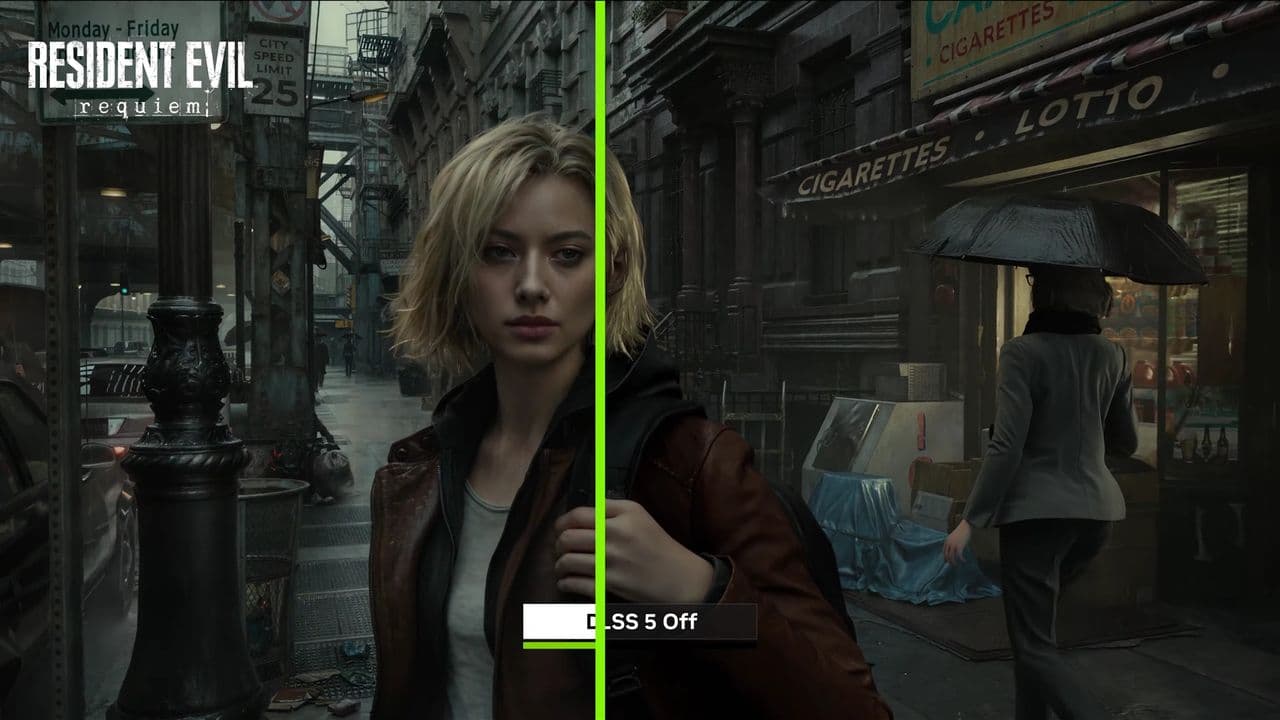
Nvidia is in full damage-control mode after DLSS 5’s reveal ignited a firestorm over “AI slop” visuals and character faces that looked outright reinterpreted. Now CEO Jensen Huang is pushing back hard, calling critics “completely wrong” and arguing the tech doesn’t change artistic control because developers can fine-tune it at the geometry and asset level. The stakes are massive: if DLSS 5 lands the way Nvidia promises, it could make path-traced lighting far more attainable—but if the early demos are representative, it risks becoming the industry’s most controversial “upgrade” button.
What Jensen Huang Actually Said—and Why Nvidia’s Framing Matters
Huang’s core rebuttal is blunt: “Well, first of all, they’re completely wrong.” His argument hinges on a specific technical distinction Nvidia wants everyone to internalize: DLSS 5 isn’t merely a post-process filter slapped on top of finished frames.
Instead, Huang says DLSS 5 “fuses controllability of the geometry and textures and everything about the game with generative AI.” He repeatedly emphasizes that developers can “fine-tune the generative AI” and that it “doesn’t change the artistic control.” In his words, it’s “not post-processing at the frame level,” but “generative control at the geometry level.”
That phrasing is doing a lot of work. Nvidia is effectively trying to rebrand the entire controversy from “AI is overriding art direction” to “developers are gaining a new art-direction tool.” Huang even positions it as a different category from the generative AI people are reacting to: “This is very different than generative AI; it’s content-control generative AI. That’s why we call it neural rendering.”
Here’s the rub: even if you accept Nvidia’s premise that developers are in control, the public-facing perception problem doesn’t go away. The backlash wasn’t born from a whitepaper—it came from side-by-side footage where the “after” shots looked like they’d been run through a taste-altering machine. Nvidia can call it “neural rendering” all day; players are reacting to what they saw.
Why DLSS 5 Set Off Alarms: Faces, “AI Sheen,” and the Fear of Homogenized Games
DLSS has historically been a performance-and-clarity conversation: upscale from a lower internal resolution, reconstruct detail, boost frame rates. DLSS 5 is being received differently because Nvidia’s demos and messaging lean into generative AI at the geometry and asset level, plus AI-enhanced lighting—and that combination can visibly change the look of a game, not just its sharpness.
A major flashpoint has been Resident Evil Requiem, where comparisons focused on protagonist Grace Ashcroft. Critics zeroed in on changes that appeared to alter her face—details like makeup and facial proportions were specifically called out in the discourse around the demo. The broader complaint is that DLSS 5 doesn’t simply “improve fidelity,” it can introduce a kind of generic AI polish that makes characters look like “yassified” doubles rather than the original artistic intent.
And that’s the nightmare scenario for art direction: not that DLSS 5 looks “bad” in a vacuum, but that it nudges everything toward the same aesthetic gravity well. If developers end up choosing from a small set of presets—or if the tech’s “best results” require a particular kind of photoreal baseline—then the fear of a homogenous AI gloss becomes very real.
Huang tries to neutralize that concern by describing wide creative flexibility—saying developers could push looks as extreme as a “toon shader” or making a game appear like it’s “made of glass.” That’s meant to signal range. But it also inadvertently reinforces what critics are worried about: DLSS 5 may be capable of reinterpreting the final scene in dramatic ways, even if it’s “under developer control.”
Control is not the same thing as restraint—and the industry has a long history of turning optional tech into default checkboxes once marketing gets involved.
Developer Control vs. Player Trust: Nvidia and Bethesda Try to Calm the Room
Nvidia’s public defense isn’t limited to Huang’s comments. The company also posted a statement emphasizing that developers will have “full, detailed artistic control” via the DLSS 5 SDK. Nvidia says those controls include:
- Intensity
- Color grading
- Masking (to prevent the effect from applying in certain areas)
Nvidia also argues DLSS 5 isn’t simply an “AI filter,” saying it uses per-frame game data—specifically color and motion vectors—as input to “anchor” the output in the source 3D content and keep results consistent frame-to-frame.
That’s the technical reassurance. The cultural reassurance is coming from developers too—most notably Bethesda, which addressed concerns after Starfield appeared in the DLSS 5 showcase. Bethesda said it would be “further adjusting the lighting and final effect” and stressed: “This will all be under our artists’ control, and totally optional for players.”
That “optional for players” line is the most important sentence anyone has said so far. Because for a lot of the audience, the fear isn’t just that DLSS 5 exists—it’s that it becomes a performance expectation, a default setting, or a visual baseline reviewers and publishers pressure teams to ship with.
In other words: if DLSS 5 is truly an artistic tool, then players need confidence they won’t be forced into it to get acceptable performance—or to match the “intended” look a publisher markets.
The Other Big Problem: DLSS 5’s Hardware Reality Is… Ugly Right Now
Even if you’re fully sold on Nvidia’s “developer-controlled neural rendering” pitch, DLSS 5 has a second, more brutal obstacle: computational cost.
At Nvidia’s GTC demos, DLSS 5 has reportedly been shown running with two RTX 5090 GPUs—one handling the game engine and another running DLSS 5 in parallel. That’s not just impractical; it’s borderline absurd as a consumer-facing showcase. Nvidia has said DLSS 5 is running on a single GPU “in the labs,” but the public demos have not reflected that.
This matters because DLSS’s entire legacy is built on pragmatism: making demanding rendering techniques more accessible. DLSS 5 is being pitched as a path to ray tracing and path tracing lighting realism without the traditional performance cliff. But if the tech’s public face is “needs dual flagship GPUs,” it undermines the pitch immediately.
The real question isn’t whether DLSS 5 can look impressive on a monster rig. The question is whether Nvidia can scale it to the GPUs most people actually own—or will buy. The blunt version: it needs to work on mainstream RTX cards, not just halo-tier hardware.
Release Window, Partners, and the Games in the Crosshairs
Nvidia has said DLSS 5 is coming later this year. A more specific date hasn’t been confirmed in the public statements referenced here, and it’s also been characterized as still months away from regular users being able to test it themselves.
Nvidia has also said DLSS 5 is supported by developers including:
- Bethesda
- Capcom
- NetEase
- NCSoft
- Tencent
- Ubisoft
- Warner Bros. Games
Several games were used in DLSS 5 showcase material and comparisons, including Resident Evil Requiem, Starfield, Hogwarts Legacy, and others shown in the demo reel.
Platform-wise, DLSS remains Nvidia’s RTX ecosystem play—so the practical platform is PC with RTX GPUs. Pricing hasn’t been announced as a standalone product because DLSS is typically delivered as part of Nvidia’s software stack and integrated by developers, but the real cost conversation is hardware: if DLSS 5’s best form demands extreme GPU horsepower, adoption will be gated by wallet and availability.
Why This Fight Isn’t Going Away
Huang’s “completely wrong” line is the kind of executive pushback that can rally loyalists—and inflame skeptics. The problem is that DLSS 5 isn’t being judged like a normal graphics feature. It’s being judged in the context of a broader, simmering resentment around AI’s impact on creative work, plus very specific anxiety about games losing their handcrafted identity.
And Nvidia’s own messaging is a double-edged sword. When you say DLSS 5 can generate at the geometry level and “fuse” itself with “everything about the game,” you’re not just promising better lighting—you’re asking artists and players to trust a generative system inside the core of the rendering pipeline.
Maybe DLSS 5 becomes a surgical tool: subtle, controllable, masked where needed, and used to make path-traced lighting viable without rewriting budgets. That’s the best-case scenario, and it would be genuinely transformative.
But the early optics—faces changing, “AI sheen,” meme-worthy comparisons—are exactly how you lose the room before anyone touches a settings menu.
What Remains Unknown
- How granular developer control really is in practice (deep per-asset tuning vs. a limited set of styles/presets hasn’t been clearly demonstrated).
- Whether DLSS 5 will run well on a single consumer GPU in real-world conditions, and what performance targets Nvidia is aiming for.
- Minimum and recommended RTX hardware for DLSS 5’s full feature set (especially if generative geometry/asset-level effects are enabled).
- How widely “player optional” will be adopted across studios beyond Bethesda’s statement.
- What DLSS 5 will look like outside curated demos, including edge cases like stylized art directions that aren’t chasing photorealism.