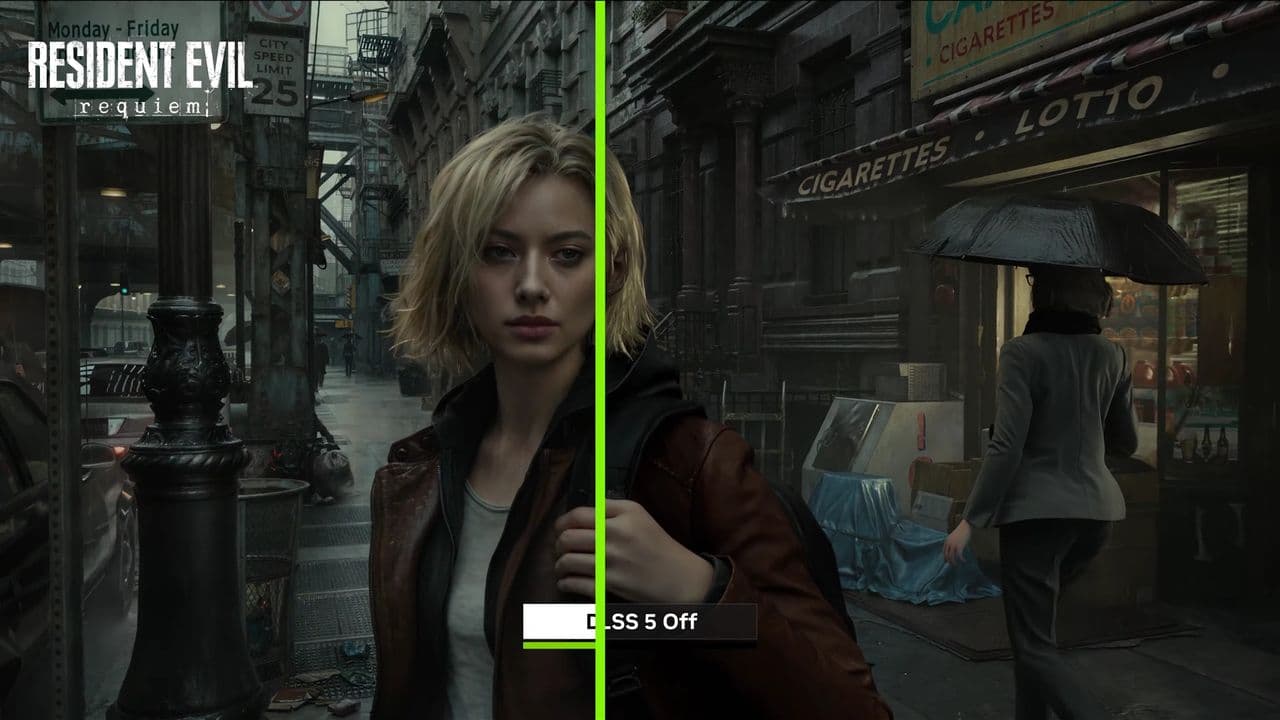
Nvidia’s DLSS 5 reveal was always going to be controversial, but now the company has effectively confirmed the core fear driving the backlash: DLSS 5 is re-drawing the final 2D frame using AI, guided by motion vectors, rather than leveraging deeper game-engine data like geometry in the way its public messaging implied. That matters because it reframes DLSS 5 from “next-gen rendering breakthrough” to something much closer to an AI overlay—with all the artistic risk, inconsistency, and “AI filter” vibes that come with it.
Even worse for Nvidia’s narrative control, the technical description attributed to GeForce Evangelist Jacob Freeman doesn’t just clarify how DLSS 5 works—it directly clashes with CEO Jensen Huang’s recent defense that it isn’t “post-processing at the frame level” and that developers have “direct control” at a geometry-driven layer.
What Nvidia Actually Confirmed DLSS 5 Uses as Input
Here’s the key detail that cuts through the marketing fog: Nvidia has now described DLSS 5’s input as a 2D frame plus motion vectors.
In a response relayed via YouTuber Daniel Owen, Nvidia’s GeForce Evangelist Jacob Freeman said: “Yes, DLSS 5 takes a 2D frame plus motion vectors as input.” He also described the model as being trained “end to end” to understand scene semantics—things like characters, hair, fabric, translucent skin, and lighting conditions such as front-lit, back-lit, or overcast—“all by analyzing a single frame.”
That’s the ballgame. If DLSS 5 is analyzing a single rendered frame (plus motion vectors), then it’s not operating with privileged access to the game’s underlying 3D truth in the way many people assumed Nvidia was implying. It’s looking at what is, functionally, the same kind of information a post-process filter would see—then generating a new version of it.
And yes, motion vectors are meaningful data. They can help stabilize temporal artifacts, predict movement, and reduce shimmer. But motion vectors don’t magically grant the model access to the full fidelity of a game’s geometry, materials, or authored lighting pipeline. They’re guidance—directional hints—while the AI does the heavy lifting of inventing detail and “improving” the image.
This is why the conversation has shifted from “Is DLSS 5 just a filter?” to “Nvidia basically admitted it.”
Jensen Huang Said Critics Were “Completely Wrong.” The Details Say Otherwise.
Nvidia CEO Jensen Huang has pushed back hard on the “AI filter” framing. At a live event later in the week, he insisted people were “completely wrong” about DLSS 5 and argued it’s not “just a filter,” describing it instead as something that “fuses the controllability of the geometry and textures […] with generative AI.”
In a Q&A, Huang also framed DLSS 5 as not being “post-processing at the frame level,” instead calling it “generative control at the geometry level,” with “direct control” by developers—positioning it as “neural rendering,” not a slap-on beautification pass.
But that’s exactly where Nvidia’s own technical description creates a credibility problem. If DLSS 5 is taking a 2D frame plus motion vectors and producing an output by analyzing that single frame, then it sure looks like it’s operating after the game has already rendered the image. That’s the definition of frame-level work, no matter how advanced the model is.
This isn’t a minor semantic dispute. It’s the difference between:
- A rendering-era shift that integrates with the game’s authored reality (geometry/material/lighting data), versus
- A generative AI re-interpretation of the final image, which can drift from the artist’s intent because it’s literally making new visual decisions.
And when Nvidia’s messaging leans on “developer control” as the safety valve, the input pipeline matters even more. If the AI isn’t grounded in the engine’s deeper data, then “control” starts to sound like a set of knobs on top of something fundamentally unpredictable.
Developer Control Sounds Limited — Because the Tech Is Fundamentally an Overlay
One of the most important practical consequences of DLSS 5 being a 2D-frame-driven system is that developers may not be able to truly “author” the result the way Nvidia’s rhetoric suggests.
Nvidia has described some developer controls, including:
- Intensity (mixing the original image with the DLSS 5 enhanced image)
- Color Grading (saturation, contrast, gamma adjustments)
- Masking (excluding certain parts of the image from DLSS 5 output)
Those are real controls—but they’re also telling. They read like the kind of controls you’d expect for a post-process layer: blend it, grade it, mask it out.
What you don’t see here (at least not in what’s been shared publicly) are the kinds of deep, asset-aware controls that would come from the AI being meaningfully integrated with the engine’s geometry, materials, and lighting systems. If DLSS 5 is essentially re-drawing what it sees, then the developer’s role becomes less “directing a renderer” and more “tuning an AI’s interpretation.”
That’s a huge shift in creative power. It’s also why the backlash isn’t just knee-jerk anti-AI noise. Games are art direction machines. They’re built on deliberate choices: stylization, texture work, lighting mood, facial character, even “imperfections” that define a look. A system that can “yassify” faces or inject photoreal materials into a stylized world isn’t merely enhancing—it’s overriding.
Why This Matters: DLSS 5 Risks Betraying Art Direction (and Trust)
DLSS as a brand earned goodwill because it was primarily sold as a performance and image-quality tool: smarter upscaling, better anti-aliasing, more frames, fewer compromises. DLSS 5, as described here, risks becoming something else entirely: a generative aesthetic layer.
Critics have already pointed to an “AI filter” look—beautification-tool vibes, uncanny faces, lighting that feels “made up,” and a general sense that the output is no longer the game’s authored image. If DLSS 5 is indeed generating new materials and lighting cues from a single frame, those concerns aren’t paranoia—they’re a predictable outcome.
The deeper issue is trust. Nvidia’s CEO publicly framed DLSS 5 as something more grounded and developer-controlled than “post-processing at the frame level.” Then Nvidia’s own representative described a pipeline that sounds exactly like frame-level generative processing.
When the message and the mechanism don’t match, the community doesn’t just get mad about the tech—they get mad about the spin.
The One Upside: DLSS 5 Could Be Easier to Apply to Older Games
There is a potential upside to DLSS 5 being “just” a 2D overlay (motion vectors included): integration could be lighter, and in theory it could be applied retroactively to more games with minimal deep engine work.
If DLSS 5 doesn’t require intimate access to geometry/material data, then it may not need the kind of bespoke per-title integration that more engine-aware solutions might demand. That could open the door to broader adoption—especially for older titles that already output the necessary frame data and motion vectors.
But that upside comes with a massive asterisk: the less grounded the AI is in the game’s authored reality, the more you risk hallucinations, inconsistent detail, and visual decisions that clash with the original look. “Works everywhere” is not the same as “works well.”
Performance Irony: DLSS 5 Is Demanding, Despite DLSS’s Original Ethos
Another uncomfortable tension: DLSS was historically pitched as a way to make demanding games run better—especially on weaker hardware—by rendering at lower resolution and reconstructing a high-quality image.
Yet the conversation around DLSS 5 is already laced with irony because it appears to be computationally intensive. There’s even discussion that it may currently require extremely high-end hardware to run smoothly, undermining the original “make games faster” ethos that made DLSS beloved in the first place.
If DLSS 5 becomes a luxury feature that eats resources to generate a “photoreal” overlay, it risks alienating the exact PC audience that championed DLSS: the people who want smarter efficiency, not heavier processing for an AI makeover.
Community Reaction: “AI Slop Filter” Isn’t Just a Meme — It’s a Fear of Homogenization
The harshest criticism of DLSS 5 has been that it looks like “AI-gen slop”—a phrase that’s doing the rounds because it captures a very specific anxiety: homogenization.
If an AI model is trained to “improve” images toward a certain notion of photoreal lighting and materials, it can sand down the edges that make games distinct. Stylized art can get pushed toward realism. Unique faces can get smoothed into the same influencer-adjacent aesthetic. Mood lighting can get “corrected” into something technically plausible but emotionally wrong.
That’s the nightmare scenario: not that DLSS 5 looks bad in every case, but that it makes everything look a little more the same.
And because DLSS 5’s described approach is based on interpreting a final frame, the fear isn’t just philosophical—it’s technical. If the model is generating detail rather than reconstructing it from engine truth, then “AI taste” becomes part of your game’s final look.
What Remains Unknown
A lot is still unclear, and Nvidia hasn’t publicly locked down several critical details:
- Release timing and rollout: No broad release date or deployment plan has been confirmed here (drivers, supported GPUs, or first supported games).
- Hardware requirements: It’s not yet clear what level of RTX hardware will be required for DLSS 5 to run well in real-world games.
- How consistent the output is across genres: Stylized games, anime shading, pixel-art-inspired 3D, and heavy post-process titles could all react differently.
- How much control developers truly get in practice: Intensity, color grading, and masking are confirmed as concepts, but the real question is whether studios can reliably preserve art direction across scenes and lighting conditions.
- Whether Nvidia will adjust messaging or implementation: With public statements and technical descriptions colliding, it’s unknown how Nvidia will reconcile the contradiction—or if it will.
DLSS 5 might still evolve into something genuinely transformative. But right now, Nvidia has a messaging problem and a perception problem—and both stem from the same uncomfortable reality: DLSS 5 is being described in a way that makes it sound like an AI overlay re-drawing games from the final frame. For a community that values artistic intent as much as frame rates, that’s not a small controversy. It’s the whole fight.