Slay the Spire 2 has a hard cap on how many cards you can hold at once: 10 cards in hand. That single number sounds simple, but in practice it’s one of the most important “invisible rules” shaping the sequel’s combat flow—especially now that Retain is back, Enchantments can fundamentally reshape individual cards, and enemies with Artifact can shut down your debuff plans until you deliberately strip their stacks.
The game is out now in Early Access on PC (Steam Deck Verified), developed and published by Mega Crit, and it’s already moving at a blistering pace—millions of sales in week one, tens of millions of runs attempted, and a steady drumbeat of updates promised without a fixed roadmap timeline. In other words: if you’re learning the systems today, you’re learning the language of the meta that’s forming in real time.
The Max Hand Size in Slay the Spire 2 Is 10 — and It’s Not Just Trivia
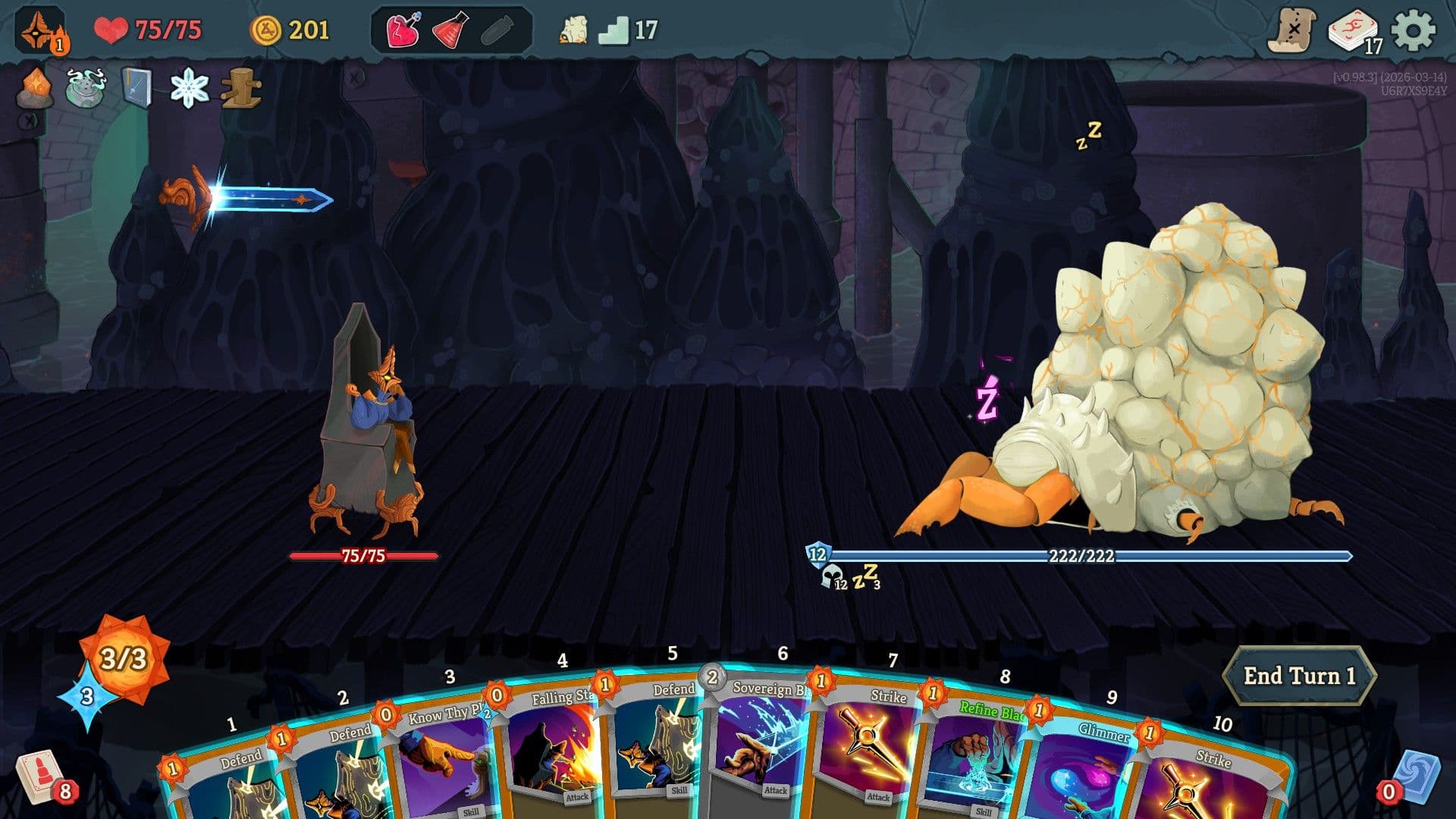
Let’s get the headline out cleanly: the maximum hand size in Slay the Spire 2 is 10 cards.
In a deckbuilding roguelike, that cap is more than a UI detail—it’s a pressure valve. Every draw effect, every “generate a card,” every Retain setup turn, every “I’ll hold this for later” decision is ultimately negotiating with that 10-card ceiling. Hit it at the wrong time and you can choke your own turn sequencing; manage it well and you can assemble explosive, deterministic turns that feel like you’re cheating (the good kind).
Mega Crit also includes a practical quality-of-life option: there’s a General Settings toggle that shows your Hand Card Count. If you’re the kind of player who likes to play fast and plan two turns ahead, turn that on. The hand cap is a rule you want visible, not something you “feel out” after you’ve already overdrawn into a mess.
Retain Returns — and It Makes the 10-Card Cap a Real Build Constraint
Retain is back in Slay the Spire 2, and it’s the mechanic that turns “10 cards max” into a real strategic limiter rather than a number you rarely notice.
Normally, your hand is discarded at end of turn. Retain breaks that rhythm by letting you carry cards between turns, which is powerful for obvious reasons: you can bank key pieces, wait for energy, and line up multi-card combos without relying on redraw luck.
But Retain also creates a new kind of failure state: hand congestion. If you’re retaining too much, you can slam into the 10-card limit and start turns already boxed in—especially if you’re also drawing extra cards or generating temporary cards. That’s when a “smart” Retain plan becomes a self-inflicted lockout where you can’t cycle, can’t find answers, and can’t convert your hand into tempo.
How to Retain Cards (and who gets it)
The most reliable way to add Retain is through cards, but not every character has equal access. Notably, Ironclad and Defect don’t have cards that add Retain, which pushes them toward other tools.
Specific Retain-related examples called out:
- Regent — Convergence: “Next turn, gain 1 Energy and 1 Star. Retain your Hand this turn.”
- Necrobinder — Snap: “Osty deals 7 damage. Add Retain to a card in your Hand.”
- Silent — Well-Laid Plans: “At the end of your turn, Retain up to 1 card.”
- Phantom — Blades: “Shivs gain Retain. The first Shiv you play deals 9 additional damage.”
If you’re on Defect or Ironclad, Retain access shifts: potions are highlighted as your best bet, and you can also look to merchant offerings like Salvo and Equilibrium.
When drawing more cards is good — and when it’s a trap
Drawing is still king in a card game because it increases option density and helps you assemble synergies efficiently. Some builds explicitly scale with draw volume—examples mentioned include Silent Murder/Discard and Necrobinder Death March/Soul decks, which “grow stronger with every card you draw in a turn.”
But the sequel is also blunt about when draw becomes actively harmful:
- You don’t have the Energy to play what you draw.
- You draw harmful Status cards (examples given include Burn and Beckon).
Now layer that onto the 10-card cap and you get the real lesson: draw and Retain are not automatically “more value.” They’re power tools that demand hand management discipline. If you’re not converting cards into impact, you’re just stockpiling problems until the cap forces a bad discard cycle.
Why Retain matters most in boss and “setup” turns
Retain shines when you’re planning around high-cost, high-impact plays that need timing and energy alignment. Examples singled out include Regent’s Stardust and Ironclad’s Demon Form—exactly the kind of cards you don’t want to gamble on redrawing at the right moment.
This is where the 10-card limit becomes a balancing act: you want to hold the right pieces, but you can’t afford to hold everything. The best players will treat Retain as a scalpel, not a hoarder’s closet.
Enchantments Can Add Retain (and More) — One Upgrade Slot, Big Consequences
If you’re coming from the original Slay the Spire, Enchantments are one of the sequel’s most exciting levers because they can change how a card behaves in ways that go beyond a simple smithing stat bump.
Here’s the key rule: each card can take one compatible Enchantment, and only one Enchantment can be applied to a given card. Enchanted cards are marked with a small tag on the upper-left of the card border, and the game surfaces the effect when you hover.
Enchantments are typically obtained via events or relics, rather than standard Rest Site smithing. They’re described as positive bonuses, though some can include drawbacks like additional HP or Energy costs.
The Enchantment that directly impacts max hand size pressure
One Enchantment in particular should make every hand-management player sit up:
- Royally Approved: “This card has Innate and Retain.”
Innate + Retain is a recipe for consistency—and also for hand cap tension. An Innate card starts in your opening hand; if it also Retains, it can become a permanent resident unless you deliberately play it. That’s incredible if it’s a core engine piece. It’s suffocating if it’s situational or if your deck already leans into draw and retention.
Other Enchantments listed include effects like cost reduction (Instinct), automatic play at combat start (Imbued), removing Exhaust (Soul’s Power), and “first time played” bonuses like Swift (draw 1) and Sown (gain Energy). The point isn’t to memorize the list—it’s to recognize that Enchantments can quietly rewrite your hand economy.
Afflictions: the dark mirror of Enchantments
Afflictions are the opposite: negative effects applied to cards, mainly via enemy attacks/effects, and they typically disappear after combat unless otherwise specified. The examples given are nasty in a very Slay-the-Spire way—limitations like only being able to play one card at a time, or taking damage when you play a Power card.
Why mention Afflictions in a max hand size discussion? Because anything that restricts your ability to convert hand into actions makes the 10-card cap more dangerous. If you can’t play down your hand, you can’t cycle. If you can’t cycle, you can’t find answers. And if you can’t find answers, the Spire does what it always does: it eats you.
Artifact Makes Debuff Plans Bounce — and That Changes What You “Hold” in Hand
Artifact is a buff that negates incoming debuffs, and it’s “mostly seen on enemies.” Enemies with Artifact are harder because they’re effectively immune to debuffs until you burn through their stacks.
The crucial mechanical detail: Artifact does not lose stacks at end of turn. You can’t turtle and wait it out. You have to spend something to remove it.
How Artifact interacts with your cards
Artifact’s interactions are clean and punishing:
- 1 Artifact stack absorbs 1 debuff type, regardless of strength (so 1 Artifact can block 5 Poison).
- If a card applies two or more different debuffs, it removes an equal number of Artifact stacks.
- If a card applies the same debuff multiple times, it removes that many Artifact stacks (example: Silent’s Bouncing Flask can remove 3 Artifact if it hits the same enemy three times).
This matters for hand management because it changes what cards are “dead” in your hand. Against Artifact enemies, your premium debuff card might do nothing—until you strip stacks. So the sequencing becomes: hold the payoff debuff card, spend smaller debuff pings to clear Artifact, then unload.
That’s a classic Retain/hand-cap puzzle: you want to bank the payoff, but you can’t clog your hand while you fish for the stripping tools.
Tools called out for stripping Artifact
Examples of cards that help remove Artifact stacks include:
- Necrobinder — Countdown: inflicts Doom at the start of every turn.
- Silent — Noxious Fumes: applies Poison at the start of every turn.
- Regent — Falling Star: applies both Vulnerable and Weak.
- Ironclad — Uppercut: applies Vulnerable and Weak.
- Defect — Beam Cell: applies Vulnerable and is free to play.
There’s also a standout answer for Silent:
- Silent — Expose: removes Artifact, removes all Block, and applies 2 Vulnerable.
And if you don’t have a debuff-centric build? You can brute force. But the guidance is clear: if you’re facing a tough elite like the Mecha Knight in Act 3, stripping Artifact “ASAP” is a major advantage because it opens the door to damage amplification and weakening enemy output.
Mega Crit’s Next Steps: Accessibility, Workshop Mods, and a Roadmap Without Dates
While players are busy optimizing hand size, Retain lines, and Artifact sequencing, Mega Crit is also talking about what’s coming next—and the tone is very deliberate: big ambitions, no strict schedule.
Community manager Demi Montes says the team doesn’t want to commit to a strict timeline for the roadmap. The big pillars remain: alternate second and third acts, more cards, extra events, and ongoing balancing.
But there are also nearer-term features on the table:
- A revamp to the badge and scoring system
- A friends-only leaderboard filter
- A “phobia accessibility mode” that lets you diminish the creepiness of the game’s most unsettling enemies (yes, Decimillipede gets singled out)
- Steam Workshop support to make modding simpler
- More multiplayer quality-of-life features
- Official Twitch plugin integration, with the hope it will let viewers browse streamers’ decks
- Continued balance patches and more final art/visual effects rollouts
Co-creator Casey Yano also commented on the game’s early success, reacting to 3,000,000 sales in its first week with: “Holy mackerel!” He added, “Even though I threw out my back from overworking, I'm feeling high in spirits.”
That matters because it frames Slay the Spire 2 as a living platform right now. If you’re learning the 10-card cap and building around Retain today, you’re not just mastering a static ruleset—you’re getting ahead of a meta that’s going to evolve as content, balance, and modding support arrive.
What Remains Unknown
- Whether any future updates will change the 10-card max hand size (no official announcement has been made).
- A dated roadmap for major content like alternate Acts, new cards, and events (Mega Crit has explicitly avoided committing to a strict schedule).
- Full details on “phobia accessibility mode,” including which enemies are affected and how the visuals will be altered.
- Timing and scope for Steam Workshop support, Twitch integration, and multiplayer quality-of-life updates (features are discussed, but release timing hasn’t been confirmed).
- The complete Enchantments pool currently available in Early Access (only those encountered so far have been enumerated).
If you take one practical lesson from all of this, it’s simple: 10 cards is the ceiling, but it’s also the metronome. Every Retain plan, every draw engine, every Enchantment that adds consistency, and every Artifact-heavy fight is ultimately asking whether you can keep your hand lean enough to breathe—while still holding the exact tools you need to win. That tension is where Slay the Spire 2 is already finding its identity.