A full year after Assassin’s Creed Shadows landed, Ubisoft is taking a victory lap—and, crucially, drawing a line under the game’s era of major post-launch investment. The team is proud of what it shipped, candid about what it learned from player feedback, and clear that the tech built for feudal Japan is meant to power the franchise’s future rather than fuel a second year of heavy updates.
That matters because Shadows wasn’t just “the Japan one.” It was a statement game: dual protagonists, a stealth-forward fantasy built around light and weather, and a production that Ubisoft now frames as a “small miracle” simply to get over the finish line.
A one-year anniversary that’s also a turning point
Assassin’s Creed Shadows launched on March 20, 2025 after a delay intended to give the team more time to polish. Over the following year, Ubisoft expanded the game’s footprint across PC, PlayStation 5, and Xbox Series X|S, and later brought it to Nintendo Switch 2 just before the holidays.
The post-launch cadence was busy. The game received stability-focused updates, a major expansion called Claws of Awaji, and even a special crossover event with Attack on Titan. That’s a chunky year by any modern live-service-adjacent standard—even for a single-player RPG-shaped blockbuster.
Now, Ubisoft says it’s entering the final phase of support for Shadows, opting to move resources to other Assassin’s Creed projects rather than commit to a second year of heavy content and long-term updates. In other words: expect maintenance and wrap-up energy, not another big season of reinvention.
“I’m proud that we shipped the game” — the team frames Shadows as a production feat
The most striking developer quote to come out of the anniversary isn’t about sales, metascores, or engagement graphs. It’s about survival.
Art director Thierry Dansereau summed up the mood bluntly: “I’m proud that we shipped the game!” He described finishing a project of this magnitude as a huge collective achievement, emphasizing the sheer number of people required to make it real.
That line lands because it’s honest in a way anniversary messaging often isn’t. Shipping a modern open-world Assassin’s Creed is an industrial act. Ubisoft isn’t pretending otherwise here—it’s leaning into the idea that getting Shadows out the door, in a state the team could stand behind, was itself the win.
And if you played it, you can see why they’d say that. Shadows is built around systems that constantly talk to each other—stealth, combat, traversal, lighting, weather, and two protagonists with different vibes and approaches. That’s the kind of design that multiplies complexity fast.
Dual protagonists: Ubisoft celebrates the bond, critics question the “choice”
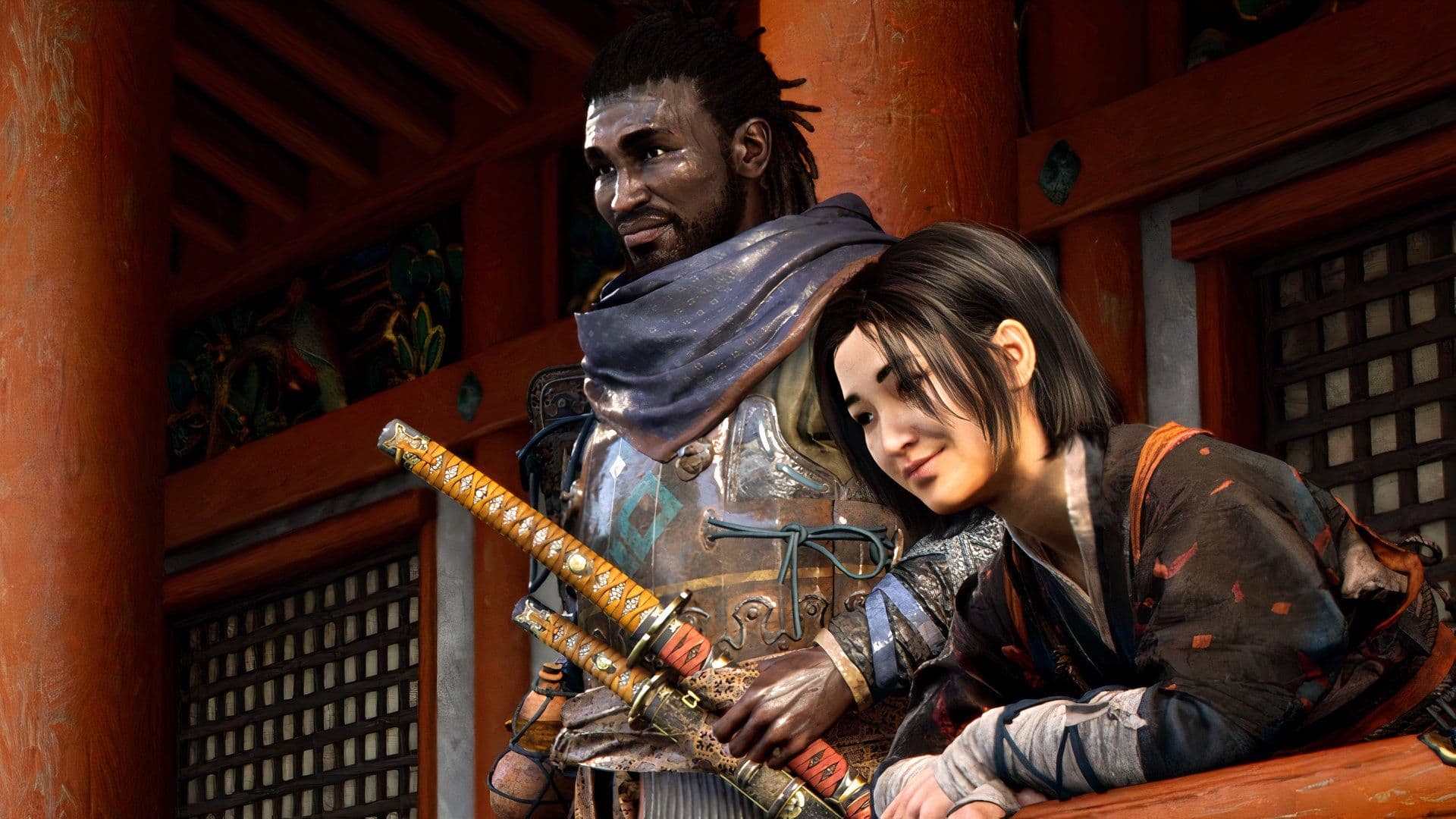
On the narrative side, Ubisoft continues to spotlight Shadows’ dual-lead structure: Naoe (shinobi) and Yasuke (samurai). The pitch was clear from day one—two perspectives on the same historical moment, two playstyles, and a story shaped by contrast.
Associate game director Simon Lemay-Comtois highlighted one moment in particular as a personal favorite: Yasuke’s cinematic arrival, where he “comes in like the Hulk and wrecks through enemy ranks” to join Naoe during a thunderstorm. The dev team has also pointed to the relationship between the two leads as a key ingredient in why the story connected—balancing emotional beats with big historical action.
But here’s where the anniversary conversation gets more interesting: not everyone thinks the dual-protagonist concept went far enough.
One prominent critique argues that by giving players choice, Shadows may have undermined its best idea—the split perspective itself. The thrust of that argument is that the game’s structure could have pushed harder into parallel character growth, especially in its second act, rather than letting the player’s flexibility soften the impact of what could’ve been a more forceful narrative design.
That’s a debate worth having because it gets at a core tension in modern Assassin’s Creed: Ubisoft wants authored drama and player-driven freedom. Shadows is being remembered as a game that tried to do both at once—sometimes elegantly, sometimes at the cost of sharper storytelling.
The tech legacy: parkour, stealth, ray-traced lighting, and the Atmos weather system
Ubisoft’s anniversary messaging isn’t subtle about what it wants to carry forward: technology.
Dansereau said the team pushed improvements across parkour, fighting, and stealth, and that the tech developed here is expected to “become legacy for future ACs.” He also called out specific rendering and world tech, including real-time ray-traced global illumination and a micropolygon system designed to make environments look more realistic.
Then there’s the Atmos system, described as a dynamic weather engine that changes lighting and rain on the fly. Ubisoft positions this as more than eye candy: it’s meant to reinforce the game’s core fantasy—light and shadow as gameplay tools, not just aesthetics.
This is the part of the anniversary reflection I find most consequential for the series. Ubisoft is effectively saying Shadows is a platform game in disguise: a big R&D push that will quietly shape how future entries move, look, and feel. If that’s true, then Shadows may end up being remembered less for any one questline and more for the foundational tech it leaves behind.
Player feedback changed the game — literally
Ubisoft also spent time talking about how direct community feedback reshaped Shadows over the year.
Lemay-Comtois described workshops where the team took “flowers as much as their jabs” from players—an unusually vivid way to describe the give-and-take of post-launch reality. That feedback loop led to a list of tangible improvements, including:
- Adding the ability to control the time of day
- Ensuring headgear stays on during important story scenes to preserve immersion
- Bringing back parkour moves like height-gaining ejects that longtime fans missed
The team has gone as far as to say it learned more about what players want in this single year than in the previous decade, and that it intends to carry a more community-focused approach into future projects.
That’s a bold claim, and it’s also a revealing one. It suggests Ubisoft sees Shadows not just as a shipped product, but as a recalibration point—where the studio re-learned what its most invested players actually value (and what they’ll loudly demand until they get it).
What’s next for Assassin’s Creed: Black Flag Resynced, Hexe, Jade, Invictus — and Netflix’s Rome series
Ubisoft isn’t letting the Shadows anniversary exist in a vacuum. The subtext is clear: the franchise machine is moving, and the team’s attention is shifting.
Here’s what Ubisoft has on the slate, as discussed alongside the anniversary reflections:
- Assassin’s Creed: Black Flag Resynced is confirmed to be in development, with Ubisoft indicating it’s targeting a release later this year.
- Assassin’s Creed Hexe is positioned as the next big blockbuster, described as witchcraft-focused and rumored to be the “darkest entry” yet, though it’s not expected until 2027 at the earliest.
- Assassin’s Creed Jade (mobile) remains in the pipeline.
- Invictus, a multiplayer experience, is said to be making steady progress.
- A live-action Netflix series is in production.
And that Netflix project is suddenly very real. Filming has begun in Rome, with the show set in Ancient Rome in 64 AD. Netflix has described the plot as an original story centered on a “secret war between two shadowy factions — one set on determining mankind’s future through control and manipulation, while the other fights to preserve free will.”
The series is being led by Roberto Patino and David Wiener as creators, showrunners, and executive producers. In a joint statement, they said they’ve been fans since the franchise debuted in 2007, adding: “Every day we work on this show, we come away excited and humbled by the possibilities that Assassin’s Creed opens to us.” They also emphasized that beneath the spectacle is a human story about identity, destiny, faith, and connection across cultures and time.
Netflix has revealed a large cast, including Toby Wallace, Lola Petticrew, Noomi Rapace, Ramzy Bedia, Sean Harris, Corrado Invernizzi, Louis McCartney, Mirren Mack, Youssef Kerkour, Claes Bang, and Sandra Guldberg-Kampp, among others. Filming is expected to run for seven months and wrap in October, and Netflix is said to be eyeing a 2027 release window, though no exact premiere date has been confirmed.
It’s hard not to see the synergy here. Ubisoft is closing the book on Shadows’ big support year while teeing up a multi-front Assassin’s Creed push: remakes, darker mainline experiments, mobile, multiplayer, and a prestige TV swing set in one of history’s most combustible eras.
What Remains Unknown
- What Ubisoft’s “final phase of support” for Assassin’s Creed Shadows will include (specific patch plans, additional events, or any further DLC have not been confirmed).
- Whether Assassin’s Creed Shadows will receive any more major content drops beyond what’s already released, including Claws of Awaji and the Attack on Titan crossover.
- The exact release date for Assassin’s Creed: Black Flag Resynced (only a “later this year” window has been indicated).
- A firm release date for Netflix’s Assassin’s Creed series (a 2027 window is being eyed, but Netflix has not confirmed a date).
- Character roles and historical figures for the Netflix series (the cast has been announced, but who plays whom hasn’t been detailed).
If Ubisoft’s anniversary reflection proves anything, it’s that Assassin’s Creed Shadows was designed to echo forward. The game may be winding down, but the tech, the lessons, and the franchise momentum it helped generate are very much still accelerating.