A throwaway visual joke from the original Pokémon anime has quietly snowballed into one of the most defining creative choices in Pokémon Pokopia—and it’s a big reason the cozy life sim has landed as one of 2026’s standout hits. Game Freak, Omega Force, and Nintendo didn’t just make Ditto playable; they made Ditto iconic, leaning into a decades-old “imperfect Transform” gag that started in a single episode and never stopped echoing through the franchise.
And the timing couldn’t be more Pokémon: as Pokémon Legends: Z-A finally gets Pokémon HOME support this week (with strict one-way transfer limitations), the brand is simultaneously tightening its ecosystem for competitive play via Pokémon Champions—while Pokopia proves there’s still enormous appetite for Pokémon that aren’t about battling at all.
The Anime Episode That Accidentally Defined Ditto Forever
If you want the origin point for Ditto’s modern identity, you don’t start with a Pokédex entry—you start with the original anime episode “Ditto’s Mysterious Mansion.”
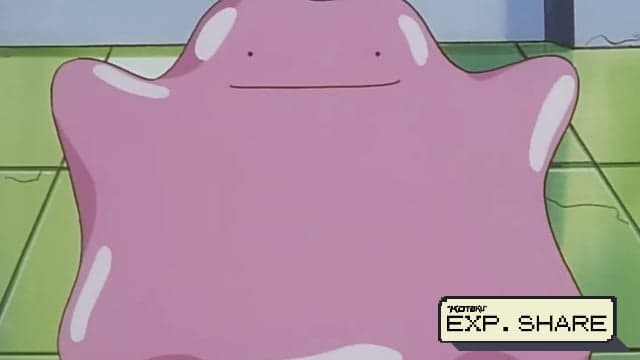
In that episode, Ash and friends take shelter from a storm in an abandoned theater and meet a Pikachu that looks… wrong. The giveaway isn’t the body shape; it’s the face. Instead of Pikachu’s normal features, it has beady eyes and a straight-line mouth. The twist: it’s not Pikachu at all, but a Ditto owned by an impressionist named Duplica, and this Ditto can’t quite get its transformations right—specifically, it can’t replicate faces properly.
That’s the key. In the games’ logic, Ditto’s move Transform should produce a near-perfect copy. The anime took that premise and introduced a flaw for comedic (and story) effect. By the end of the episode, Ditto learns to replicate faces and the show goes on—classic self-contained anime plot.
But the “mistake” stuck.
Over the years, Ditto’s slightly-off transformations became a recurring visual language across the franchise: sometimes a discolored sprite, sometimes the now-famous blank expression, and sometimes something in-between. Even the live-action Detective Pikachu film leaned into it: a character is revealed to be a Ditto in disguise when she removes sunglasses to reveal those unmistakable Ditto eyes underneath—an intentionally unsettling moment that only works because the audience already understands the shorthand.
Here’s the fascinating part: the franchise has effectively chosen to keep the imperfection, even when it contradicts the “perfect copy” idea. Not because it’s lore-consistent, but because it’s brand-consistent. Ditto’s “wrong face” is now as recognizable as Ditto itself.
Why Pokémon Pokopia Makes Ditto’s “Wrong Face” the Whole Point
Pokémon Pokopia (Nintendo Switch 2) takes that long-running Ditto identity and builds an entire player fantasy around it. This isn’t Ditto as a gimmick, a breeding utility, or a novelty. This is Ditto as a protagonist—front and center.
The premise is wonderfully strange: you play as a Ditto transformed to look like a human, rebuilding a desolate world into a cozy utopia through crafting, building, gardening, and habitat construction. You can invite Pokémon and other players to visit your base via local wireless or online, and there’s even GameShare support that lets you host friends on Nintendo Switch 2 or Nintendo Switch even if they don’t own the game.
But the creative masterstroke is this: you can customize skin tone, clothes, and hairstyle—yet you can’t change the face. The Ditto face stays. Always.
That means when your Ditto transforms into Pokémon like Dragonite or Lapras for travel, the “closest facsimile” it can manage still carries that blank, beady-eyed stare. When it uses moves like Strength and Cut to help build habitats and structures, it’s still Ditto—visibly Ditto—no matter what shape it’s wearing.
That choice matters because it solves a problem Ditto has always had in games: if Ditto becomes a perfect copy of everything else, it risks becoming visually anonymous. The anime’s “imperfect Transform” gag—originally a one-off—turns out to be the perfect solution for a playable Ditto in a modern game. It preserves identity while still delivering the fantasy of shapeshifting.
And yes, fans are already doing what Pokémon fans do best: turning a design choice into a heartbreak theory. One popular interpretation is that Pokopia’s Ditto keeps its own face because, after so long, it’s forgotten its trainer’s face—an unexpectedly tragic angle for a cozy life sim. It’s not confirmed as canon, but it speaks to how effectively Pokopia uses Ditto’s established “wrongness” to create emotional texture.
Whether you read it as melancholy or simply as The Pokémon Company cementing Ditto’s modern default look, the result is the same: Pokopia makes Ditto feel like a character, not a mechanic.
A Hit Cozy Life Sim in a Franchise That Usually Can’t Stop Battling
It’s worth underlining how unusual Pokémon Pokopia is in the broader Pokémon landscape. Mystery Gifts in the mainline RPGs historically meant battle items or special Pokémon. In Pokopia, Pokémon don’t battle at all—so the entire reward structure shifts toward decor, habitats, and town-building momentum.
That’s not a small pivot. It’s a statement: Pokémon can carry a full-scale release on vibes, creativity, and community expression—without leaning on gyms, the Elite Four, or competitive metas.
And the market seems to be responding. Pokopia has been widely received as a hit for Game Freak, Omega Force, and Nintendo, and it’s already being talked about as one of the best games of 2026. Even in the broader “big releases” conversation, it’s being compared alongside heavy hitters like Crimson Desert—a totally different genre and tone, yet still part of the same 2026 success story.
That contrast is the real headline beneath the headline: 2026 is already proving there’s room for both sprawling open-world RPG spectacle and a Pokémon life sim where your biggest win of the day is placing the perfect plant next to the perfect habitat.
The Pokémon Ecosystem Is Tightening: Pokémon HOME Finally Supports Legends: Z-A (and Champions Is Next)
While Pokopia is thriving on cozy creativity, the more traditional Pokémon pipeline is also making a long-awaited move: Pokémon Legends: Z-A is finally getting Pokémon HOME connectivity nearly six months after launch.
The update hits this week, with Pokémon HOME on Switch and mobile updating to Version 4.0.0. Maintenance is scheduled for April 2 at 00:00 UTC to 06:00 UTC, and during that window Pokémon HOME will be temporarily unavailable. Rollout timing can vary, so service may return earlier or later than planned.
Once it’s live, players can transfer Pokémon between HOME and Pokémon Legends: Z-A—but the limitations are strict and familiar:
- Only Pokémon that can appear in Legends: Z-A’s Pokédex can be transferred into the game.
- Pokémon cannot be transferred backward from Legends: Z-A to earlier titles.
- If you transfer a Pokémon from an older game into Legends: Z-A, it cannot go back to that original game afterward.
This is the modern Pokémon reality: forward momentum only.
And it’s not happening in a vacuum. Pokémon Champions—a “free-to-start” battle simulator coming to Switch and mobile—launches April 8, and HOME connectivity has been confirmed for it as well. The practical implication is obvious: HOME is becoming the staging ground for the next era of competitive Pokémon, and Legends: Z-A Pokémon can be brought forward into Champions.
There’s another notable competitive wrinkle: Legends: Z-A doesn’t include Abilities (passive perks that shape strategy), but Champions will bring Abilities into play for Z-A’s new Mega Evolutions—meaning those forms are effectively being “completed” for competitive use in the new platform.
Several Mega Evolution Abilities have already been identified for Champions, including:
- Mega Dragonite — Multiscale
- Mega Meganium — Mega Sol (a new ability tied to harsh sunlight perks without the usual sunlight drawbacks described)
- Mega Feraligatr — Dragonize (turns Normal-type attacks into Dragon-type with a 20% power boost; Mega Feraligatr becomes Water/Dragon)
- Mega Froslass — Snow Warning
- Mega Emboar — Mold Breaker
- Mega Chesnaught — Bulletproof
- Mega Delphox — Levitate
- Mega Greninja — Protean
Plenty of Mega Evolutions still have Abilities unaccounted for so far, and that drip-feed of information is exactly the kind of slow-burn meta fuel competitive players live on.
Mystery Gifts, Freebies, and the Cozy Endgame: Pokopia’s Latest Distribution
If you’re deep into Pokémon Pokopia right now, the game is already doing what modern Pokémon does best: keeping players checking in with limited-time goodies.
A new Mystery Gift distribution is live, offering a free Chansey Plant. You can redeem it at a Pokémon Center terminal by going to Mystery Gift and selecting “Get with Code/Password.” The code is:
P0K0P1AGARDENS
You have until October 7, 2026 to redeem it. It’s also not exclusive long-term—players can still craft the item and related habitat after the date—but the free drop is a nice early boost, especially since the Chansey Plant can be used to craft a Chansey resting area habitat.
There’s also mention of a special event giving players a chance to claim an inflatable Sudowoodo, continuing the game’s steady stream of decor-first rewards that fit its non-battle identity.
This is where Pokopia feels particularly smart: it’s taking the familiar Pokémon live-ops cadence (Mystery Gifts, timed distributions, community chatter) and redirecting it toward the things that matter in a life sim—town aesthetics, habitat completion, and creative expression.
Why This Ditto Story Matters More Than Trivia
It’s easy to treat “Ditto’s blank face” as a meme—one of those franchise quirks that exists mostly for plushies and punchlines. But Pokémon Pokopia proves it’s more than that. It’s a rare example of Pokémon taking a long-running, semi-accidental piece of iconography and using it as the foundation for a modern game’s identity.
This is the butterfly effect in action: a single anime episode trying to tell a cute story about an imperfect performer ends up shaping decades of character design decisions. Those decisions then make it possible for Ditto to carry an entire game as a protagonist without disappearing into the forms it copies.
And in a year where Pokémon is also formalizing its competitive future through Pokémon Champions and tightening its transfer ecosystem via Pokémon HOME, Pokopia stands out as a reminder that Pokémon’s biggest strength isn’t just battling—it’s character. Ditto’s face, ironically, is what gives it one.
What Remains Unknown
- Pokémon Pokopia platforms beyond Nintendo Switch 2: no official announcement has been made for other platforms.
- Pokémon Pokopia sales figures and official performance metrics: it’s widely described as a hit, but specific numbers haven’t been confirmed here.
- Full Ability list for every new Mega Evolution in Pokémon Champions: several have been revealed, but many remain unaccounted for.
- Exact Pokémon availability list for Pokémon HOME transfers into Pokémon Legends: Z-A: it’s confirmed transfers are limited to Pokémon that can appear in the game, but the full compatible roster hasn’t been detailed here.
- Whether the “Ditto forgot its trainer’s face” interpretation is canon: it’s a fan theory, not an official story confirmation.