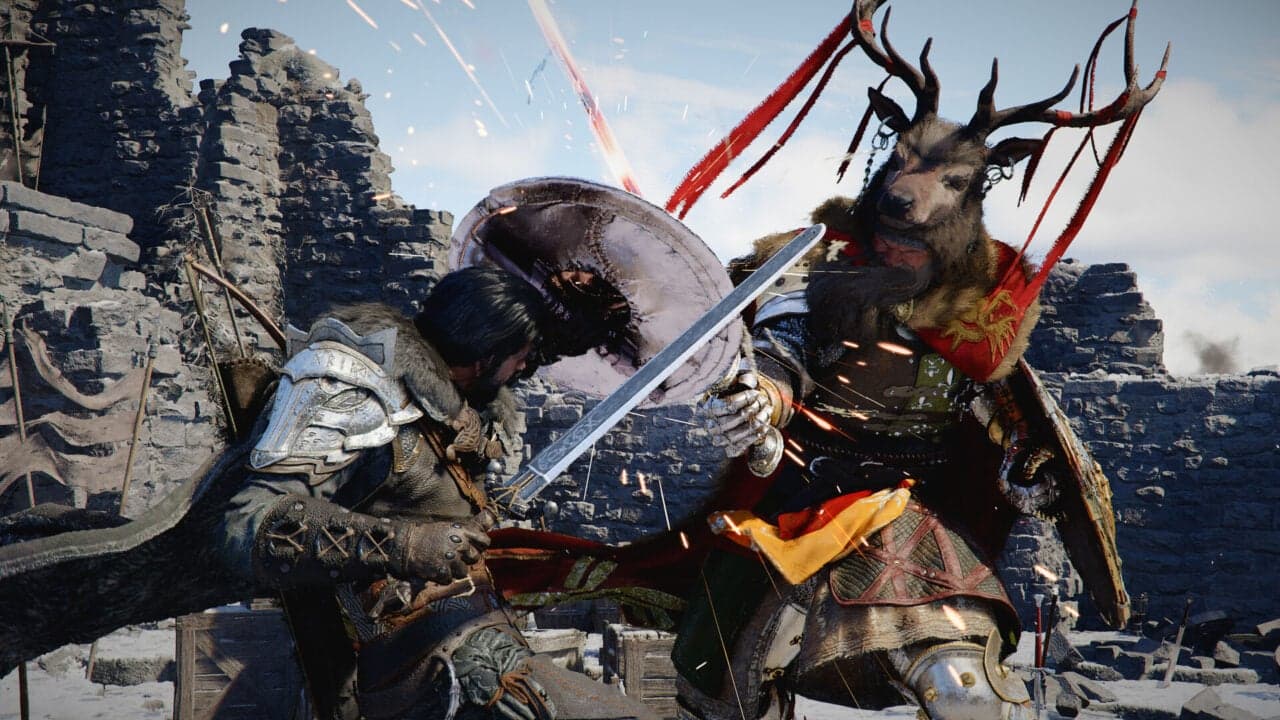
Pearl Abyss’ long-gestating fantasy blockbuster Crimson Desert lands March 19 on PS5, Xbox Series X|S, and PC, and the first wave of reviews paints a clear picture: this is a gorgeous, technically impressive open-world swing that often forgets to be meaningfully engaging. Critics keep circling the same push-and-pull—spectacle, scale, and combat highs colliding with messy storytelling, clunky systems, and design decisions that feel like MMO habits refusing to die.
The result isn’t a disaster, but it’s also not the “second coming” of open-world games some of the hype machine promised. Right now, the consensus is “good, frustrating, and frequently exhausting,” with aggregate scores hovering around the high-70s on major review trackers.
What the Reviews Agree On: Pywel Is Massive, Beautiful… and Sometimes Empty
If there’s one thing Crimson Desert seems to do effortlessly, it’s sell the fantasy at a glance. Reviewers repeatedly praise the sheer visual fidelity and the sense of scale across Pywel, the game’s continent-spanning setting filled with rival factions, mythical creatures, and big postcard vistas that practically beg for Photo Mode.
That admiration isn’t just about pretty lighting. Critics call out the density of stuff—ruins, caves, puzzles, bosses, and sprawling biomes—plus the technical ambition of rendering an enormous world that looks and runs impressively on PC setups described in reviews. Even writers who bounced off the game’s structure still tend to concede that simply existing in Pywel can be compelling.
But that’s where the split begins: for a chunk of critics, the world’s scale doesn’t translate into consistent discovery. Some impressions describe long stretches where the “open world” feels more like a gigantic stage waiting for the main quest to authorize fun, with exploration that can feel gated or unrewarding outside of specific activities like environmental puzzles.
In other words: Crimson Desert can look like a dream open-world vacation—and still leave you wondering why you booked the trip.
Combat Is the Hook—Until Bosses, Controls, and Systems Start Fighting You
The most consistent bright spot across reviews is third-person combat. Writers praise the physicality and variety: weapon types that feel distinct, flashy skills, and even absurd wrestling-style moves that make brawls feel uniquely aggressive compared to the usual fantasy sword-swinging.
Several reviews also highlight how satisfying it can be to stumble into big fights or take on challenging encounters once you’ve learned the game’s rhythms. There’s a recurring sense that Crimson Desert can be thrilling when it’s letting you cut loose.
Then the other shoe drops: bosses and friction.
A common complaint is difficulty spikes and boss design that can tip from exhilarating into punishing, with some critics describing fights that devolve into endurance tests—less “learn the pattern,” more “did you bring enough food to heal through it?” That frustration is often compounded by camera/lock-on quirks and an overall control scheme that multiple writers describe as awkward, overloaded, or inconsistent.
And it’s not just combat. Reviewers repeatedly point to a thicket of systems—crafting, upgrading, resource gathering, camp growth, faction activities, puzzles, traversal tools—that can feel like they’re competing for attention rather than supporting a clean, confident core loop. The phrase “jack of all trades” comes up for a reason: Crimson Desert tries to be everything, and critics argue it doesn’t always refine those ideas into something cohesive.
The Biggest Knock: A Weak Story, Thin Characters, and “MMO Brain” Design
For a game positioned as a massive single-player action-adventure, the most damaging recurring critique is the narrative. Multiple reviews call the story confusing, undercooked, or simply uninteresting—especially when compared to the genre’s heavy hitters like The Witcher 3: Wild Hunt or Red Dead Redemption 2.
You play as Kliff, leader (or de facto leader) of the mercenary group the Greymanes, thrown into a revenge-and-reunion setup after an ambush by rivals the Black Bears. The premise sounds like it should be a sturdy backbone for a sprawling adventure. Critics, however, often describe Kliff as stoic to the point of emptiness, with characterization that doesn’t carry the emotional weight the game seems to want in its big moments.
Even reviews that enjoy the game tend to frame the narrative as the thing you tolerate while chasing the next great fight, puzzle, or vista. One critic memorably likens the overall “taste” of the world to a banquet where most dishes are faintly cardboard—technically impressive, visually gleaming, but lacking distinct flavor.
Then there’s the design philosophy that keeps getting labeled as MMO-like: systems that feel intentionally time-consuming, progression that can be stingy early on, and quality-of-life omissions that make basic play feel more laborious than it needs to be. The most infamous example across reviews is inventory management, with critics describing constant interruptions to juggle limited space because everything takes up slots—gear, crafting materials, tools, quest items, cooking ingredients, cooked meals, notes, collectibles, and more.
That friction becomes a theme: Crimson Desert isn’t just big—it’s big in a way that can feel like it’s wasting your time.
Platform and Performance Controversy: Reviews Are PC-Only (For Now)
Here’s the part that should make console players pause: the review code situation is unusual.
Across coverage, one key detail stands out—advance review access was limited to the PC version, and as reviews went live, there were no PS5 or Xbox Series X|S critic reviews logged on major aggregators. That means the critical consensus you’re seeing at launch is overwhelmingly shaped by how the game plays on Windows PC, not on consoles.
That doesn’t automatically mean console versions are in trouble—but it does mean buyers are being asked to take a leap of faith on day one. The situation has been compared (carefully, with caveats) to past launches where console performance was a major unknown until release.
There are at least some encouraging signals on PlayStation hardware: Digital Foundry previously tested PS5 Pro and came away impressed, noting stable frame rates across multiple modes except in heavy enemy scenarios, and praising visual details like tides and smoke casting shadows. However, that preview did not test the base PS5 model. There is also a 20-minute base PS5 gameplay video published by PlayStation Japan, but it’s still not the same as broad hands-on testing from critics across varied scenarios.
On Xbox, Pearl Abyss has indicated it won’t showcase Xbox Series X|S gameplay footage ahead of launch, directing attention instead to official specs. Reported mode details include:
- Xbox Series X: Performance / Quality / Balanced modes, with AMD FSR 3 upscaling to 4K; Performance cited as 1080p/60 FPS (with VRR potentially pushing above 60), and Quality cited as upscaled 4K from 1440p at 30 FPS with ray tracing on High.
- Xbox Series S: only Performance (720p/40 FPS) and Quality (1080p/30 FPS), no upscaling, and ray tracing disabled.
For a game selling itself on spectacle, this platform uncertainty matters. If you’re buying on PS5 or Xbox, you’re not just choosing a controller—you’re choosing how much risk you’re willing to accept at launch.
So… Is Crimson Desert Worth It?
The most honest takeaway from this review wave is that Crimson Desert is a Rorschach test for open-world tolerance.
If you love maximalist sandboxes—games where you can wander off, chase puzzles, hunt bosses, tinker with progression, and get lost in a world that’s constantly showing off—critics suggest there’s absolutely something here for you. Some reviewers are genuinely enamored, praising the ambition and the sheer volume of things to do, with at least one high-profile review arguing it delivers on the promise of a massive, entertaining adventure.
But if you’re coming for a tight narrative, clean quest design, streamlined systems, or a world that consistently rewards curiosity with meaningful stories and surprises, the critical mood is far more cautious. Even positive reviews often read like they’re recommending a project—a game you learn to love by navigating around its rough edges.
And those rough edges aren’t small. They’re foundational: story, UI, inventory, pacing, boss balance, and a design ethos that can feel like it’s dragging MMO baggage into a single-player blockbuster.
What Remains Unknown
- How the PS5 and Xbox Series X|S versions perform in real-world play, since critics largely reviewed PC ahead of launch.
- How the base PS5 holds up under stress, beyond limited officially released footage and PS5 Pro-focused technical impressions.
- Whether post-launch updates will address major quality-of-life complaints, including storage/inventory friction and other system-level frustrations (some reviews note storage improvements are planned, but timing hasn’t been confirmed).
- IGN’s final verdict, since its published assessment is currently a review-in-progress without a final score.
Crimson Desert releases March 19, 2026 on PlayStation 5, Xbox Series X|S, and PC. If you’re on console and sensitive to performance or stability, waiting for hands-on console analysis may be the smartest move—because right now, the loudest consensus isn’t “masterpiece” or “trainwreck.” It’s “spectacular… and stubbornly flawed.”