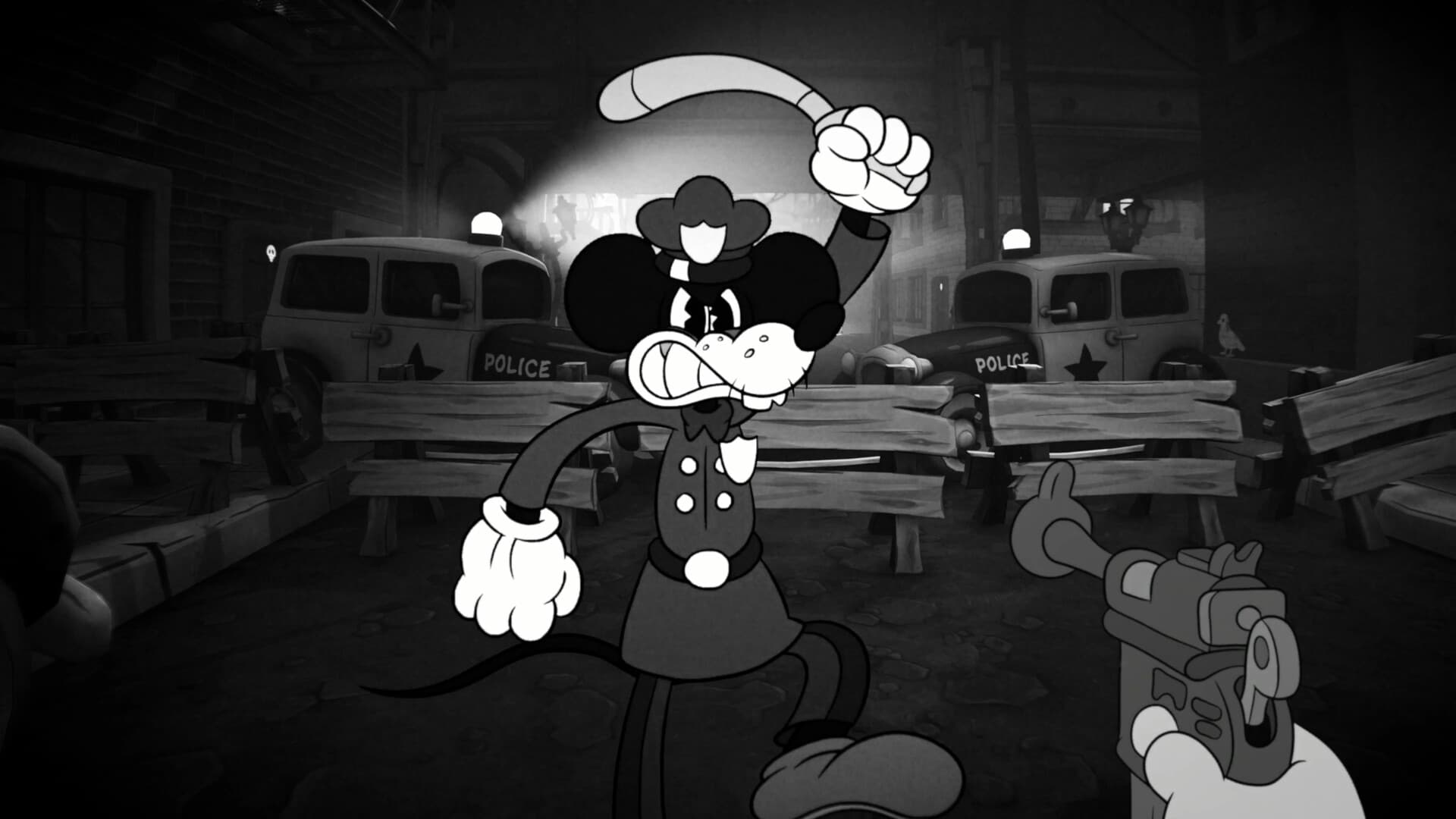
Fumi Games’ debut, MOUSE: P.I. For Hire, is finally here—and it’s not just a viral art-style flex. Across early reviews, this black-and-white rubberhose noir shooter lands as a confident, characterful FPS with a jazzy pulse, a surprisingly hefty campaign (roughly 12–15 hours in multiple playthroughs), and enough slapstick cartoon invention to stand out in a crowded first-person shooter year. The catch: the “detective” part is more flavor than function, and the combat—while often satisfying—can drift into repetition depending on your tolerance for boomer-shooter structure.
The game launches April 16, 2026 on Nintendo Switch 2, PlayStation 5, Windows PC, and Xbox Series X/S, with PS4, Nintendo Switch, and Xbox One versions coming later. On PC, it’s priced at $30/£25.
The Vibe Is the Hook: Rubberhose Noir Done With Real Craft
The immediate headline is still the same one that made MOUSE: P.I. For Hire go viral years ago: it commits, completely, to a 1930s-inspired monochrome rubberhose cartoon aesthetic. Reviews consistently highlight how striking the presentation is—not just in character animation and weapon sprites, but in the way the whole world sells the illusion of playing inside an old theatrical short.
What impressed critics more than the look itself is how playable it remains. There were pre-release worries that a grayscale palette and busy linework would make enemies and interactables hard to read, but at least one reviewer noted that visibility simply wasn’t an issue in practice. Another praised the way levels guide you forward without relying on the usual modern trick of colored lighting, instead using layout and spatial logic.
And then there’s the soundscape: noir jazz, big band energy, and a dense layer of period-appropriate audio gags. Multiple impressions call out the soundtrack as a constant driver of tone—music and sound effects working together to make everything feel “bouncy,” from UI animations to movement sounds.
This is also where the game’s personality really shows. The writing is packed with cheese puns—aggressively so, by several accounts—and it’s paired with a cast that leans hard into noir archetypes and cartoon exaggeration. Troy Baker voices protagonist Jack Pepper, and reviewers widely agree he brings the exact kind of gruff, committed performance the role needs. Supporting performances were also singled out in at least one review, including Florian Clare (Wanda Fuller), Camryn Grimes (Tammy Tumbler), Fred Tatasciore (John Brown), and Frank Todaro (Cornelius Stilton).
A Shooter First, a Detective Story Second (Third?)
You play as Jack Pepper, a war-hero-turned-private investigator in Mouseburg, pulled into a missing persons case that spirals into a broader conspiracy. Depending on the review, that includes elements like crooked cops, organized crime, political rot, shrew disappearances/trafficking, and more. One take describes the story as veering into much wilder territory—robots and “creepy monsters” among them—while another frames it as a noir mystery that’s constantly tossing new twists into the mix.
But here’s the consistent caveat: this is not a detective game in the mechanical sense.
Several reviews point out that investigative systems are guided. Clues get gathered, pinned to a board, and progress tends to be driven by quest updates and clearly signposted next steps. One critic explicitly wished for more player-driven sleuthing, noting that Jack often “automatically” does the organizing and the game is more interested in keeping you moving to the next set piece than letting you truly deduce.
That doesn’t mean the detective framing is wasted. Reviewers repeatedly praise the downtime structure—returning to a hub (Jack’s office and nearby spots) between missions, talking to NPCs, and soaking in the world. Multiple impressions compare this rhythm to a “hub-and-spoke” flow, giving the campaign a satisfying cadence: action, breath, banter, back to action.
And the locations sound like they’re having fun with the premise. Across reviews, levels include places like opera houses, swamps, production studios, sewers, and a riverboat party, plus more that some reviewers avoided spoiling. The slapstick interaction is a big part of the identity: shoot ropes to drop pianos and anvils, spot environmental gags, and keep an eye out for secrets (including one “totally normal wall!” gag that signals destructible surfaces).
Combat: Satisfying Guns, Smart Movement… and Some Genre Trappings
The core truth you should walk in with: you will spend most of your time shooting.
One review estimates combat makes up 80% of the experience; another describes levels as being combat-heavy to the point that progression often means clearing enemies before moving on. That’s not inherently a knock—several critics outright call it one of the best shooters they’ve played in years—but it does define who this game is for.
On the feel side, the gunplay and movement get a lot of love. The arsenal includes staples like a pistol and shotgun, plus the “James Gun” (a Tommy Gun riff that multiple reviewers mention by name). As the campaign opens up, weapons get stranger—some reviews reference exotic or sci-fi-leaning options and alternate fire modes, including guns that apply status effects (like freezing) or corrosive damage. Upgrades come via blueprints, and at least one critic notes the upgrade path can feel too straightforward.
Movement abilities are gradually unlocked—double jump, wall run, and gliding are specifically mentioned, and another review references a grapple alongside dash/double jump. The consensus is that traversal tools help exploration and sometimes combat, but not everyone agrees the game fully capitalizes on them. One critique argues later abilities don’t feel distinct enough, and that earlier unlocks often cover what levels demand.
Enemy and encounter design is where opinions start to split. Some reviewers praise the campaign’s pacing and variety—shortcuts, secrets, warp-pipe-style routes, and boss fights that keep things fresh. Others argue combat spaces can be too contained, limiting the kind of constant motion that defines the best boomer shooters. There’s also criticism that many enemies fall into broad buckets (melee chargers and stationary shooters), which can flatten the tactical texture over time.
Boss fights, though, are repeatedly highlighted as a bright spot. One review describes wacky, challenging showdowns that force you to use your full kit—like timing cannon shots against an enemy moving between windows, or using a flashlight against an apparition that splits into copies. Another praises most bosses as memorable, with one exception described as more busywork than spectacle.
As for difficulty, impressions vary. One reviewer mentions late-game difficulty spikes; another notes that on a hard setting, ammo and health pickups still felt abundant. The game also uses frequent save points via typewriters, which one critic felt became redundant given autosaves and how often they appear.
Side Activities, Secrets, and the Baseball Card Minigame
If you’re the kind of player who can’t resist checking every corner, MOUSE: P.I. For Hire seems built to reward that compulsion.
Reviews mention secret areas packed with money and collectibles, plus optional requests/side jobs from NPCs. One critic says those side jobs meaningfully expand relationships and deliver some of the funniest dialogue—while another argues side jobs are too few and add limited value. So your mileage may vary depending on how deep you want the optional content to be.
The most consistently mentioned diversion is the baseball card minigame. Multiple reviews bring it up, and not as a throwaway: one critic lost hours to it, while another got hooked enough to seek out roadhouses on the world map to buy better cards. At least one review describes it as a simple “high-card-wins” style game, while another critic complains it’s too easy to farm tokens by repeatedly beating the same opponent, which undercuts any sense of escalation.
Verdict: A Stylish, Confident FPS With a Mystery Wrapper—and a Few Rough Edges
The broad critical takeaway is clear: Fumi Games didn’t just ship a gimmick. MOUSE: P.I. For Hire is being praised as a legitimately accomplished shooter with standout atmosphere, a committed aesthetic, strong voice work (especially Troy Baker), and a campaign that keeps throwing new cartoon-noir set pieces at you.
But it’s also not universally viewed as flawless. The most common knocks are that the detective mechanics are largely guided, the combat can become repetitive (especially later), progression systems can feel streamlined, and there are occasional bugs or AI/pathfinding hiccups. One outlet’s take is notably harsher, arguing the game’s pieces don’t fully click together—even while acknowledging the Steamboat Willie-inspired presentation.
If you’re here for boomer shooter energy, a noir mystery vibe, and a world that’s practically dripping with cartoon charm and cheese puns, this looks like one of 2026’s most distinctive FPS releases. Just don’t expect it to reinvent detective gameplay—and be ready to do a whole lot of shooting in the name of “investigation.”
What Remains Unknown
Even with reviews landing, a few practical details still aren’t fully clear:
- Exact release dates for PS4, Nintendo Switch, and Xbox One versions beyond “coming later.”
- Nintendo Switch 2 and console performance specifics (resolution, frame rate targets, and modes) haven’t been broadly detailed in the review excerpts available.
- Steam Deck status is listed as TBA in at least one PC-focused review.
- Full platform pricing parity (console storefront prices) hasn’t been uniformly confirmed across coverage, beyond the PC price point cited.